
Panduan Utama Anda untuk Membeli Mesin Pembuat Blok Beton yang Dijual (2024)
Pengantar
Membangun bisnis konstruksi yang menguntungkan atau memperluas kapasitas produksi Anda? Mesin pembuat blok beton yang tepat adalah investasi paling kritis Anda. Itu adalah mesin operasi Anda, yang menentukan output, kualitas produk, dan pada akhirnya, laba bersih Anda. Namun, menavigasi pasar luas mesin yang dijual bisa menjadi tugas yang menakutkan, dipenuhi dengan istilah teknis dan taruhan finansial yang signifikan.
Panduan komprehensif 2024 ini, yang disusun berdasarkan pengalaman industri selama puluhan tahun, akan menjadi peta jalan terpercaya Anda. Kami akan menyederhanakan kerumitan untuk membantu Anda memahami dengan tepat apa yang harus dicari dalam sebuahmesin pembuat blok beton untuk dijualAnda akan belajar cara mencocokkan tipe mesin dengan tujuan spesifik Anda, memahami faktor-faktor penentu harga, mengevaluasi produsen dengan kritis, serta menghindari kesalahan umum yang berbiaya mahal. Di akhir sesi, Anda akan dibekali kemampuan untuk mengambil keputusan pembelian yang terinformasi dan percaya diri, yang akan mendukung pertumbuhan Anda selama bertahun-tahun ke depan.
Memahami Mesin Pembuat Blok Beton: Jenis dan Aplikasinya
Sebelum menyelami spesifikasi dan harga, penting untuk memahami kategori dasar mesin yang tersedia. Pilihan yang tepat bergantung pada skala produksi, anggaran, dan strategi tenaga kerja Anda.
Mesin Blok Manual vs. Semi-Otomatis vs. Otomatis Penuh
Tingkat otomasi adalah pembeda utama dalam mesin blok, yang secara langsung mempengaruhi output, biaya tenaga kerja, dan investasi awal.
-
Mesin Pembuat Blok Manual:
- Operasi:Sepenuhnya digerakkan oleh tenaga manusia. Operator mengisi cetakan secara manual, menekan beton (seringkali melalui tuas), dan melepas cetakan dari balok.
- Tenaga Kerja & Output:Intensitas tenaga kerja tinggi, hasil produksi sangat rendah (biasanya 100-500 blok per hari). Cocok untuk 1-2 operator.
- Rekomendasi Ahli:Ideal untuk startup skala sangat kecil, proyek komunitas, atau di daerah terpencil dengan ketersediaan daya rendah dan modal terbatas. Mereka merupakan titik masuk berisiko rendah tetapi tidak untuk produksi volume komersial.
-
Mesin Pembuat Blok Semi-Otomatis:
- Operasi:Mekanisasi proses pemadatan inti (melalui getaran dan tekanan hidrolik) tetapi memerlukan pengisian bahan baku secara manual serta pengangkatan/palletisasi blok jadi.
- Tenaga Kerja & Output:Kebutuhan tenaga kerja sedang (2-4 orang), hasil produksi baik (1.000 hingga 6.000+ balok per shift 8 jam, tergantung model).
- Rekomendasi Ahli:Titik ideal bagi sebagian besar usaha kecil dan menengah (UKM). Mereka menawarkan keseimbangan yang sangat baik antara keterjangkauan, peningkatan laju produksi, dan konsistensi kualitas blok. Sempurna untuk bisnis yang ingin berkembang dari operasi manual.
-
Mesin Pembuat Blok Sepenuhnya Otomatis:
- Operasi:Sepenuhnya diotomatisasi melalui sistem PLC (Programmable Logic Controller). Mereka dilengkapi dengan pengumpanan material otomatis, pencetakan, pemadatan, pengerasan, dan penumpukan. Seringkali menjadi bagian dari lini produksi lengkap.
- Tenaga Kerja & Output:Tenaga kerja minimal (untuk pengawasan dan pemeliharaan), hasil sangat tinggi (8.000 hingga 20.000+ blok per shift).
- Rekomendasi Ahli:Disediakan untuk pabrik skala besar dan kontrak volume tinggi. Investasi modal yang signifikan dibenarkan oleh efisiensi tak tertandingi, biaya per unit lebih rendah, dan konsistensi superior. Memerlukan pasokan listrik yang andal dan perawatan yang lebih canggih.
Mesin Pembuat Blok Stasioner vs. Mesin Blok Seluler
Perbedaan ini berkaitan dengan mobilitas mesin dan jejak pemasangannya.
-
Mesin Pembuat Blok Stasioner:
- Ini adalah instalasi tetap, biasanya dipasang di atas fondasi beton padat di pabrik atau halaman khusus.
- Mereka umumnya lebih kokoh, bertenaga, dan mampu menghasilkan volume produksi yang lebih tinggi.
- Aplikasi:Pilihan standar untuk pabrik pembuatan blok permanen yang memasok pasar regional.
-
Mesin Pembuat Blok Mobile (atau "Egg-Layers"):
- Unit-unit ini dipasang di atas roda atau trailer. Mereka memproduksi blok secara langsung di tanah atau di atas lempengan beton, lalu bergerak maju untuk meletakkan tumpukan berikutnya.
- Mereka lebih sederhana, seringkali membutuhkan pekerjaan pondasi yang lebih sedikit, dan sangat portabel.
- Aplikasi:Sangat baik untuk produksi di lokasi proyek konstruksi besar (misalnya, membangun kompleks perumahan) di mana pengangkutan blok-blok tersebut mahal. Ini menghilangkan kerusakan dan biaya transportasi.
Produk Unggulan: Apa yang Dapat Anda Produksi?
Potensi bisnis Anda tidak terbatas pada blok standar. Fleksibilitas mesin, yang ditentukan oleh sistem cetakannya, mendefinisikan katalog produk Anda.
- Bata Ringan:Produk yang paling umum untuk konstruksi, menawarkan rasio kekuatan terhadap berat dan isolasi yang sangat baik.
- Balok Padat: Used for heavier load-bearing applications and paving.
- Lempengan Paving & Paving Saling Mengunci: For driveways, walkways, and patios. A high-demand market in landscaping and municipal work.
- Curb Stones & Kerbs: Essential for road construction and landscaping projects.
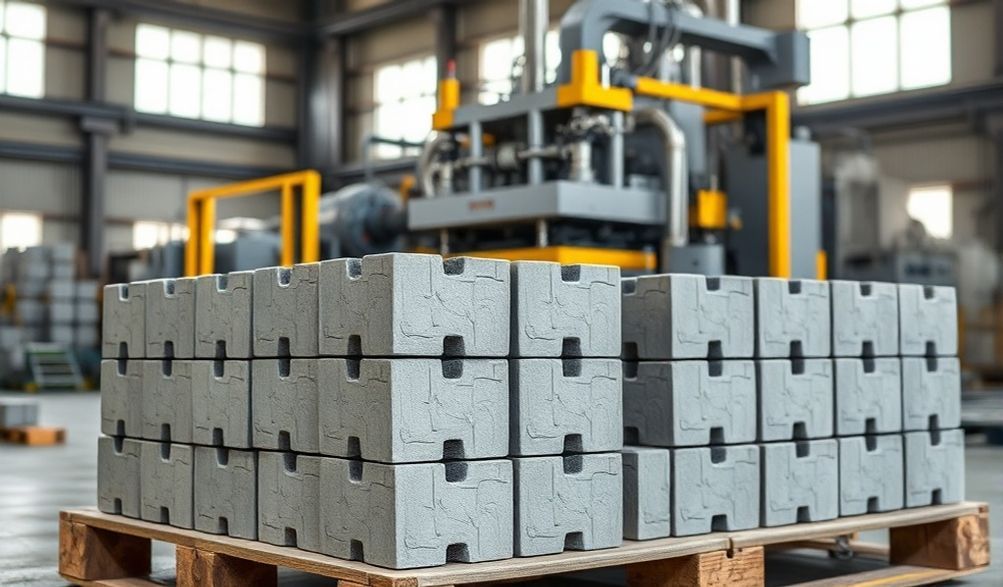
- Bentuk Khusus: Interlocking blocks for retaining walls, chimney blocks, and decorative landscaping units.
Wawasan Ahli: When evaluating a mesin pembuat blok beton untuk dijual, inquire about the mold compatibility and cost. A machine that allows for quick mold changes with a wide range of available mold designs enables you to pivot with market demands and capture diverse revenue streams.
Faktor-Faktor Penting yang Perlu Dipertimbangkan Sebelum Membeli
Armed with an understanding of machine types, you must now drill down into the specifics that separate a wise investment from a costly mistake.
Kapasitas Produksi & Persyaratan Keluaran
Don’t just look at the “maximum” output in a brochure. Think practically.
- Cycles per Hour & Blocks per Cycle: Multiply these figures to get the theoretical hourly output. A machine with a 10-second cycle time producing 4 blocks per cycle can theoretically make 1,440 blocks per hour.
- Real-World Calculation: Deduct time for mold changes, maintenance breaks, material loading delays, and operator shifts. A realistic daily output is often 70-80% of the theoretical maximum.
- Penyesuaian dengan Tujuan: Align the machine’s realistic output with your current orders and projected growth for the next 3-5 years. Buying slightly more capacity than you need today is often smarter than outgrowing a machine too quickly.
Machine Specifications & Technical Details
These are the nuts and bolts that determine performance and longevity.
- Tekanan (Tonase): Higher compaction pressure (measured in tons) generally produces denser, stronger blocks. For standard hollow blocks, machines range from 50 to 400+ tons.
- Persyaratan Daya: Manuals may need no power, while semi-automatics often use a standard 3-phase motor (e.g., 380V/50Hz or 440V/60Hz). Verify your local power supply.
- Sistem Getaran: This is critical for compacting the concrete and releasing air bubbles. Look for durable, high-frequency vibrators mounted effectively within the mold table.
- Sistem Kontrol: From simple relay logic to touch-screen PLCs. More advanced controls offer precision, diagnostic tools, and easier operation.
- Trust Factor: Always ask about the availability of technical manuals, wiring diagrams, and spare parts lists. A supplier’s reluctance to provide these is a major red flag.
Quality of Construction & Key Components
This is where “you get what you pay for” becomes starkly real.
- Bingkai & Struktur: The frame should be made from heavy-duty, reinforced steel plate to withstand constant vibration and pressure without warping.
- Sistem Hidrolik: The heart of an automatic machine. Look for reputable component brands (e.g., Bosch Rexroth, Parker, Yuken) and a well-designed, accessible system with proper filtration and cooling.
- Jamur: These are high-wear items. They should be made from hardened, high-chrome steel for longevity and precise block dimensions.
- Authoritative Benchmark: Reputable manufacturers will often build to recognized standards (like ISO) and can provide material certificates for critical components. Don’t hesitate to ask for them.
Space, Logistics, and Foundation Needs
A machine isn’t just the machine itself.
- Factory Space: You need space for the machine, raw material storage (aggregates, cement), a mixing area, a curing area, and finished product storage. Include space for forklift movement.
- Foundation: Most stationary machines require a solid, level concrete foundation of specified thickness to absorb vibrations. The supplier should provide detailed foundation drawings.
- Logistics: Consider the machine’s shipping dimensions and weight. Do you have access for a delivery truck? Do you need a crane or heavy forklift for unloading and placement?
Navigating the Market: Cost, Suppliers, and Selection
This is the phase where due diligence separates successful buyers from regretful ones.
Concrete Block Making Machine Price Ranges
Prices vary astronomically based on the factors we’ve discussed. Here’s a transparent 2024 overview:
- Mesin Manual: $1,000 – $5,000 USD.
- Mesin Semi-Otomatis: $8,000 – $50,000+ USD. A robust, mid-capacity model for SME production typically starts around $15,000-$25,000.
- Fully Automatic Machines / Production Lines: $50,000 – $300,000+ USD. Single-pallet fully automatic machines start around $50k-$80k, while large multi-pallet lines with full automation can reach several hundred thousand.
Critical Expertise Note: The initial purchase price is just one part of the Total Cost of Ownership (TCO). A cheaper, poorly supported machine can cost far more in downtime, repair costs, and lost production than a higher-quality, well-supported alternative.
How to Choose a Reputable Manufacturer or Supplier
Your relationship with the supplier is as important as the machine itself. Use this checklist:
- Sejarah & Reputasi Perusahaan: How long have they been in business? Search for their brand name online alongside keywords like “review,” “problem,” or “service.” A 10+ year track record is a good sign.
- Quality Evidence: Do they have quality management certifications (ISO)? Can they provide test reports or videos of the machine in operation? Will they share material certificates for key parts?
- After-Sales Support Structure: This is non-negotiable. Do they have technical support staff? What is the warranty period and what does it cover? Is there a stock of commonly needed spare parts? Do they offer installation supervision and operator training?
- Transparency & References: A trustworthy supplier will be proud to connect you with previous customers in your region or a similar industry. They should also be open to a factory visit or a live video tour of their production facility.
- Red Flags: Extremely low prices, pressure to pay via insecure methods, vague company addresses, inability to communicate clearly in your language, and no physical contact details.
New vs. Used Concrete Block Making Machines
A used machine can be a great value—or a money pit.
- New Machine Pros: Full warranty, latest technology, customized to your needs, reliable performance from day one.
- Used Machine Pros: Lower upfront cost, potential for faster delivery, depreciation already absorbed.
- Used Machine Inspection Checklist:
- Hours/Cycles: Check the machine’s service hour meter or get an estimate of total production cycles.
- Physical Inspection: Look for cracks in the frame, signs of weld repairs, hydraulic oil leaks, and excessive wear on molds and vibrators.
- Test Run: Selalu insist on seeing the machine under power, producing blocks. Listen for unusual noises in the hydraulics or vibrations.
- Dokumentasi: Request the original manuals, part lists, and maintenance history.
Maximizing Your Investment: Operation and Beyond
Your new machine is the centerpiece, but its success depends on the ecosystem around it.
Essential Auxiliary Equipment
Rarely does a machine work in isolation. Consider these for an efficient line:
- Pengaduk Beton: A pan mixer or planetary mixer ensures a consistent, homogenous mix, which is vital for block quality.
- Sistem Konveyor: Transports mixed concrete to the machine hopper, saving labor and time.
- Sistem Pengumpan/Sirkulasi Palet: Automatic systems move pallets in and out of the machine, crucial for high-output automation.
- Block Curing System: This can be a simple rack system in a sheltered yard or a sophisticated steam curing chamber for faster strength gain.
- Forklift or Block Clamp: Essential for handling raw materials and moving stacks of finished blocks.
Raw Material Considerations for Optimal Blocks
The machine can only form what you feed it.
- Desain Campuran: A proper ratio of cement, sand, aggregate (gravel or crushed stone), and water is critical. The water-cement ratio directly affects strength.
- Aggregate Size: Must be compatible with your mold dimensions—typically between 5mm and 10mm for standard blocks.
- Consistency is Key: Variations in raw material quality or moisture content will lead to inconsistent block density and strength, causing production issues and customer complaints.
The Importance of After-Sales Support
The sale is the beginning of the relationship, not the end.
- Pemasangan & Pengoperasian: Professional setup ensures the machine is level, calibrated, and operating safely from the start.
- Pelatihan Komprehensif: Operators must be trained not just on how to run the machine, but on basic troubleshooting, daily maintenance, and safety protocols.
- Warranty & Long-Term Support: Understand the response time for technical queries. How quickly can they ship a critical spare part? A supplier with a strong support network is investing in your long-term success.
Pertanyaan yang Sering Diajukan (FAQ)
Q: What is the average cost of a concrete block making machine for sale?
A: As detailed above, there’s no single “average.” Prices range from around $1,000 for a basic manual model to well over $200,000 for a high-capacity, fully automatic production line. Your final cost depends on automation level, capacity, brand, and included support.
Q: How many blocks can a standard machine produce per day?
A: Output varies dramatically. A mesin semi-otomatis might produce 2,000 to 6,000 standard hollow blocks in an 8-hour shift. A fully automatic single-pallet machine can produce 8,000 to 15,000, while large multi-pallet lines can exceed 20,000 blocks per day.
Q: Can one machine produce different block types and sizes?
A: Yes, absolutely. This is achieved through cetakan yang dapat dipertukarkan. However, factor in the cost of additional molds and the time required for mold changeover, which can temporarily halt production.
Q: What kind of power supply is needed?
A: It depends entirely on the machine. Small manuals may need none. Semi-automatic and automatic machines almost always require a three-phase industrial power supply (commonly 380V/50Hz or 440V/60Hz). Always confirm the exact voltage and power (kW) requirements with the supplier before purchase.
Q: How do I ensure I’m choosing a trustworthy supplier?
A: Follow the checklist in the guide: verify their business history, ask for quality certifications, demand details on after-sales service and spare parts, and always request customer references or a factory visit. A reputable company will be transparent and eager to prove its credibility.
Kesimpulan
Purchasing a mesin pembuat blok beton untuk dijual is a pivotal decision that hinges on careful planning and informed selection. We’ve walked through the essential pillars: defining your production needs and scale, understanding the core differences between manual, semi-automatic, and automatic systems, and prioritizing durable construction and robust after-sales support over price alone.
Remember, this machine is a long-term partner in your business growth. The most cost-effective choice isn’t the cheapest sticker price, but the machine—backed by a reputable supplier—that delivers reliable, efficient production for years with minimal downtime. Thorough research and partnering with experienced, trustworthy experts are the true foundations of your success in the block manufacturing industry.
Ready to take the next step? Browse our curated selection of verified, high-performance concrete block making machines for sale, or contact our team of technical experts today for a free, no-obligation consultation tailored to your project goals.
<