
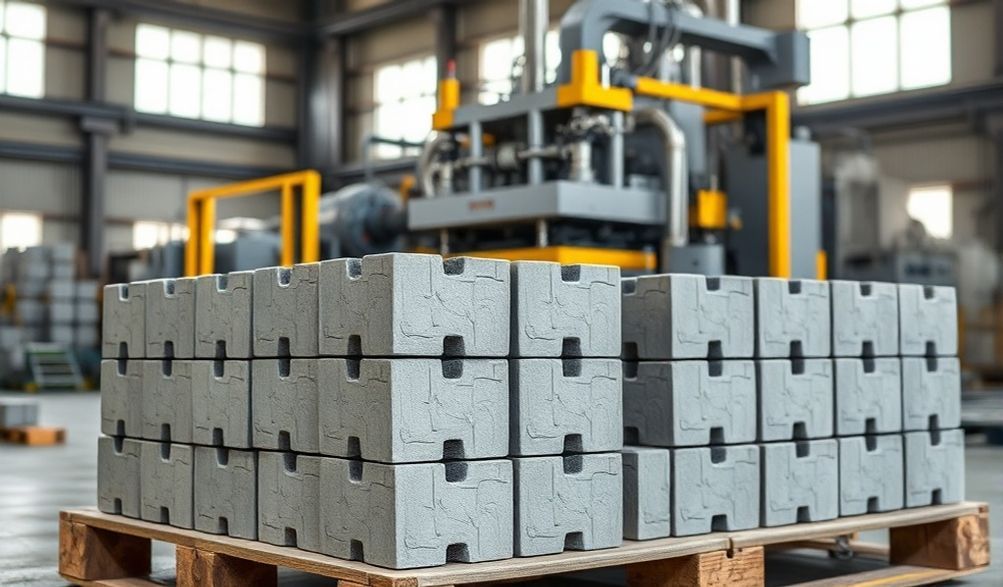
Hagahaada Ugu Wanaagsan ee Iibsashada Makiinada Sameynta Boodhka Siman ee iibka Laga Helayo (2024)
Hordhac
Dhisa ganacsi hantiyeed oo faa'iido leh ama kordhi awoodda wax soo saarkaada? Makiinada saxda ah ee sameynta biraha simenti waa maalgashigaaga ugu muhiimsan. Waa injiinka hawlahaaga, oo go'aaminaya wax soo saarkaada, tayada alaabtaada, iyo ugu dambeyntii, khadkaaga hoose. Si kastaba ha ahaatee, dhex marista suuqa ballaaran ee makiinadaha la iibiyo waa hawl adag, oo ka kooban ereyo farsamo iyo khatar maaliyadeed oo muhiim ah.
Halkan waa hagaha oo dhan ee 2024, oo ku saleysan khibrado sanado badan oo ganacsi, kaas oo noqon doona khariidad aad ku kalsoon tahay. Waxaan ka saari doonnaa qaybaha adag si aan kuu caawinno inaad si sax ah u fahamto waxa ugu muhiimsan ee ay tahay inaad raadiso.mashiinka sameynta blookyada simento ee iibka ahWaxaad baran doontaa sida aad ugu habboonayso noocyada mashiinnada ujeedadaada gaarka ah, fahamka sababaha qiimaha, qiimeynta soosaarayaasha si fiican, iyo ka fogaanida khataaraha caadiga ah ee qiimaha badan. Dhamaadka, waxaad diyaar u noqon doontaa inaad sameyso go’aan iibsasho oo xog ogaal ah, kalsooni leh oo kor u qaadi doona horumarkaaga sanadaha soo socda.
Fahamka Makiinadaha Sameynta Biriqyada Siman: Noocyada iyo Codsiyada
Kahor intaadan u daba galin faahfaahinta iyo qiimaha, waa muhiim inaad fahanto qaybaha aasaasiga ah ee mashiinnada la heli karo. Doorashada saxda ah waxay ku xiran tahay heerka wax soo saarkaada, miisaaniyaddaada, iyo xeeladaada shaqaale.
Gacanta vs. Nus-awtomaatig ah vs. Mashinada Block-ka oo Awtomaatig oo Dhamaystiran
Heerka otomaashada waa isbeddelaha ugu muhiimsan ee makiinadaha laamiga, taas oo si toos ah u saamaynaysa soo saarka, kharashka shaqaalaha, iyo maalgashiga bilowga.
-
Makiinadaha Qalabka La Isku Dhaafo ee Laamaha.
- Hawlgalka:Waxaa ka shaqeeya dad kaliya. Shaqaaluhu si gacanta ah ayaa ay ku buuxiyaan qaabka, ay sii xoogga saaraan koonkariitada (inta badan mararka qaarkood iyagoo adeegsanaya miishaan), oo ay ka saaraan qaabka.
- Shaqo & Soo-saarka:Shaqo badan oo ku habboon, soo saarista aad u hooseysa (guud ahaan 100-500 oo buug oo maalin walba). Ku habboon 1-2 hawl-wadeen.
- Khasaare ahaan la soo jeediyay:Waxay ku habboon yihiin mashruucyada bilowga ah ee aad u yar, mashruucyada bulshada, ama meelaha fog ee aan lahayn tamar iyo maal badan. Waxay noqon karaan meel u furan oo khatar yar leh, laakiin ma ahan wax lagu soo saaro tiro ganacsi.
-
Makiinada Yar ee Dhismaha Block-ka:
- Hawlgalka:Waxaa uu u dhaqaaqiyaa habka isku dhufashada qaybta ugu muhiimsan (iyadoo la adeegsanayo gariir iyo cadaadis hidroolik) laakiin wuxuu u baahan yahay dhaqdhaqaaqa gacanta ee soo saarista alaabta la shaqeynayo iyo saarista/bakoolinta alaabta la dhammaystiray.
- Shaqo & Soo-saarka:Baahida shaqo ee dhexdhexaad ah (2-4 qof), soo saarista wanaagsan (1,000 ilaa 6,000+ oo buul oo ku beegan 8-saacadood, ku xiran nooca).
- Khasaare ahaan la soo jeediyay:Xarigga macquulka ah ee ganacsatada yar ilaa dhexdhexaad. Waxay bixiyaan isku dheelitirnaan wanaagsan oo u dhexeeya qiimo jaban, korodh celcelis ah oo wax soo saar, iyo isku mid ay tahay tayada blookada. Ku habboon ganacsatada doonaya inay ka korodhsadaan hawlaha gacanta.
-
Makiinadaha Balaastariga ee Si Toos ah u Shaqeeya:
- Hawlgalka:Waxaa si toos ah loo isticmaalaa nidaamka PLC (Maamulaha Mantiqada Barmijin karta). Waxay leeyihiin soo saarista otomaatig ah oo alaabta ah, qaabeynta, isku-dhafka, daaweynta, iyo isku-dhigista. Inta badan waa qayb ka mid ah taxane buuxa oo soo saar.
- Shaqo & Soo-saarka: Minimal labor (for supervision and maintenance), very high output (8,000 to 20,000+ blocks per shift).
- Khasaare ahaan la soo jeediyay: Reserved for large-scale commercial plants and high-volume contracts. The significant capital investment is justified by unmatched efficiency, lower per-unit cost, and superior consistency. Requires reliable power and more sophisticated maintenance.
Makiinadaha Dhismaha Blocyada Isku-jiida vs. Makiinadaha Blocyada Mobilka
This distinction relates to the machine’s mobility and installation footprint.
-
Makiinadaha Dhismo ee Joogto ah:
- These are fixed installations, typically mounted on a solid concrete foundation in a factory or dedicated yard.
- They are generally more robust, powerful, and capable of higher production volumes.
- Application: The standard choice for permanent block manufacturing plants supplying a regional market.
-
Mobile Block Making Machines (or “Egg-Layers”):
- These units are mounted on wheels or a trailer. They produce blocks directly on the ground or on a concrete slab, then move forward to lay the next batch.
- They are simpler, often require less foundation work, and are highly portable.
- Application: Excellent for on-site production for large construction projects (e.g., building a housing complex) where transporting blocks is costly. They eliminate transport damage and costs.
Key Products: What Can You Manufacture?
Your business potential isn’t limited to standard blocks. Machine versatility, determined by its mold system, defines your product catalog.
- Qeybaha Dusha sare ee Dhismaha (Hollow Blocks): The most common product for construction, offering excellent strength-to-weight ratio and insulation.
- Goobooyaan Adag: Used for heavier load-bearing applications and paving.
- Farshaxanka Laamiga ah & Laamiga Isku-xirka: For driveways, walkways, and patios. A high-demand market in landscaping and municipal work.
- Curb Stones & Kerbs: Essential for road construction and landscaping projects.
- Qaabab Gaar ah: Interlocking blocks for retaining walls, chimney blocks, and decorative landscaping units.
Expert Insight: When evaluating a mashiinka sameynta blookyada simento ee iibka ah, inquire about the mold compatibility and cost. A machine that allows for quick mold changes with a wide range of available mold designs enables you to pivot with market demands and capture diverse revenue streams.
Faa'iidooyinka Muhiimka ah ee Loo Baahan Yahay Ka Hor Intaadan Iibsan
Armed with an understanding of machine types, you must now drill down into the specifics that separate a wise investment from a costly mistake.
Wax-soo-saarka Awoodda & Shuruudaha Wax-soo-saarka
Don’t just look at the “maximum” output in a brochure. Think practically.
- Cycles per Hour & Blocks per Cycle: Multiply these figures to get the theoretical hourly output. A machine with a 10-second cycle time producing 4 blocks per cycle can theoretically make 1,440 blocks per hour.
- Real-World Calculation: Deduct time for mold changes, maintenance breaks, material loading delays, and operator shifts. A realistic daily output is often 70-80% of the theoretical maximum.
- Matching to Goals: Align the machine’s realistic output with your current orders and projected growth for the next 3-5 years. Buying slightly more capacity than you need today is often smarter than outgrowing a machine too quickly.
Machine Specifications & Technical Details
These are the nuts and bolts that determine performance and longevity.
- Cadaadis (Tonnage): Higher compaction pressure (measured in tons) generally produces denser, stronger blocks. For standard hollow blocks, machines range from 50 to 400+ tons.
- Shuruudaha Korontada: Manuals may need no power, while semi-automatics often use a standard 3-phase motor (e.g., 380V/50Hz or 440V/60Hz). Verify your local power supply.
- Nidaamka Gariirka: This is critical for compacting the concrete and releasing air bubbles. Look for durable, high-frequency vibrators mounted effectively within the mold table.
- Nidaamka Maamulka: From simple relay logic to touch-screen PLCs. More advanced controls offer precision, diagnostic tools, and easier operation.
- Trust Factor: Always ask about the availability of technical manuals, wiring diagrams, and spare parts lists. A supplier’s reluctance to provide these is a major red flag.
Quality of Construction & Key Components
This is where “you get what you pay for” becomes starkly real.
- Qaabka & Qaabka Dhismaha The frame should be made from heavy-duty, reinforced steel plate to withstand constant vibration and pressure without warping.
- Nidaamka Hydraulic: The heart of an automatic machine. Look for reputable component brands (e.g., Bosch Rexroth, Parker, Yuken) and a well-designed, accessible system with proper filtration and cooling.
- Qorraxda: These are high-wear items. They should be made from hardened, high-chrome steel for longevity and precise block dimensions.
- Authoritative Benchmark: Reputable manufacturers will often build to recognized standards (like ISO) and can provide material certificates for critical components. Don’t hesitate to ask for them.
Space, Logistics, and Foundation Needs
A machine isn’t just the machine itself.
- Factory Space: You need space for the machine, raw material storage (aggregates, cement), a mixing area, a curing area, and finished product storage. Include space for forklift movement.
- Foundation: Most stationary machines require a solid, level concrete foundation of specified thickness to absorb vibrations. The supplier should provide detailed foundation drawings.
- Logistics: Consider the machine’s shipping dimensions and weight. Do you have access for a delivery truck? Do you need a crane or heavy forklift for unloading and placement?
Navigating the Market: Cost, Suppliers, and Selection
This is the phase where due diligence separates successful buyers from regretful ones.
Concrete Block Making Machine Price Ranges
Prices vary astronomically based on the factors we’ve discussed. Here’s a transparent 2024 overview:
- Makiinada Gacanta: $1,000 – $5,000 USD.
- Makiinnada Yar-otoomaatig ah: $8,000 – $50,000+ USD. A robust, mid-capacity model for SME production typically starts around $15,000-$25,000.
- Fully Automatic Machines / Production Lines: $50,000 – $300,000+ USD. Single-pallet fully automatic machines start around $50k-$80k, while large multi-pallet lines with full automation can reach several hundred thousand.
Critical Expertise Note: The initial purchase price is just one part of the Total Cost of Ownership (TCO). A cheaper, poorly supported machine can cost far more in downtime, repair costs, and lost production than a higher-quality, well-supported alternative.
How to Choose a Reputable Manufacturer or Supplier
Your relationship with the supplier is as important as the machine itself. Use this checklist:
- Company History & Reputation: How long have they been in business? Search for their brand name online alongside keywords like “review,” “problem,” or “service.” A 10+ year track record is a good sign.
- Quality Evidence: Do they have quality management certifications (ISO)? Can they provide test reports or videos of the machine in operation? Will they share material certificates for key parts?
- After-Sales Support Structure: This is non-negotiable. Do they have technical support staff? What is the warranty period and what does it cover? Is there a stock of commonly needed spare parts? Do they offer installation supervision and operator training?
- Transparency & References: A trustworthy supplier will be proud to connect you with previous customers in your region or a similar industry. They should also be open to a factory visit or a live video tour of their production facility.
- Calaamadaha Khaas ah: Extremely low prices, pressure to pay via insecure methods, vague company addresses, inability to communicate clearly in your language, and no physical contact details.
New vs. Used Concrete Block Making Machines
A used machine can be a great value—or a money pit.
- New Machine Pros: Full warranty, latest technology, customized to your needs, reliable performance from day one.
- Used Machine Pros: Lower upfront cost, potential for faster delivery, depreciation already absorbed.
- Used Machine Inspection Checklist:
- Hours/Cycles: Check the machine’s service hour meter or get an estimate of total production cycles.
- Physical Inspection: Look for cracks in the frame, signs of weld repairs, hydraulic oil leaks, and excessive wear on molds and vibrators.
- Test Run: Had iyo goor insist on seeing the machine under power, producing blocks. Listen for unusual noises in the hydraulics or vibrations.
- Documentation: Request the original manuals, part lists, and maintenance history.
Maximizing Your Investment: Operation and Beyond
Your new machine is the centerpiece, but its success depends on the ecosystem around it.
Essential Auxiliary Equipment
Rarely does a machine work in isolation. Consider these for an efficient line:
- Qalabka Isku Dhista Simento: A pan mixer or planetary mixer ensures a consistent, homogenous mix, which is vital for block quality.
- Nidaamka Qaadista Transports mixed concrete to the machine hopper, saving labor and time.
- Pallet Feeder/Circulation System: Automatic systems move pallets in and out of the machine, crucial for high-output automation.
- Block Curing System: This can be a simple rack system in a sheltered yard or a sophisticated steam curing chamber for faster strength gain.
- Forklift or Block Clamp: Essential for handling raw materials and moving stacks of finished blocks.
Raw Material Considerations for Optimal Blocks
The machine can only form what you feed it.
- Mix Design: A proper ratio of cement, sand, aggregate (gravel or crushed stone), and water is critical. The water-cement ratio directly affects strength.
- Aggregate Size: Must be compatible with your mold dimensions—typically between 5mm and 10mm for standard blocks.
- Consistency is Key: Variations in raw material quality or moisture content will lead to inconsistent block density and strength, causing production issues and customer complaints.
The Importance of After-Sales Support
The sale is the beginning of the relationship, not the end.
- Isku-dhajinta & Ka-qaybgalka: Professional setup ensures the machine is level, calibrated, and operating safely from the start.
- Tababarka Guud Operators must be trained not just on how to run the machine, but on basic troubleshooting, daily maintenance, and safety protocols.
- Warranty & Long-Term Support: Understand the response time for technical queries. How quickly can they ship a critical spare part? A supplier with a strong support network is investing in your long-term success.
Su'aalaha Inta Badan La Is Weydiiyo (FAQ)
Q: What is the average cost of a concrete block making machine for sale?
A: As detailed above, there’s no single “average.” Prices range from around $1,000 for a basic manual model to well over $200,000 for a high-capacity, fully automatic production line. Your final cost depends on automation level, capacity, brand, and included support.
Q: How many blocks can a standard machine produce per day?
A: Output varies dramatically. A mashinka dheeri ah oo otomaatig ah might produce 2,000 to 6,000 standard hollow blocks in an 8-hour shift. A fully automatic single-pallet machine can produce 8,000 to 15,000, while large multi-pallet lines can exceed 20,000 blocks per day.
Q: Can one machine produce different block types and sizes?
A: Yes, absolutely. This is achieved through interchangeable molds. However, factor in the cost of additional molds and the time required for mold changeover, which can temporarily halt production.
Q: What kind of power supply is needed?
A: It depends entirely on the machine. Small manuals may need none. Semi-automatic and automatic machines almost always require a three-phase industrial power supply (commonly 380V/50Hz or 440V/60Hz). Always confirm the exact voltage and power (kW) requirements with the supplier before purchase.
Q: How do I ensure I’m choosing a trustworthy supplier?
A: Follow the checklist in the guide: verify their business history, ask for quality certifications, demand details on after-sales service and spare parts, and always request customer references or a factory visit. A reputable company will be transparent and eager to prove its credibility.
Gabagabo
Purchasing a mashiinka sameynta blookyada simento ee iibka ah is a pivotal decision that hinges on careful planning and informed selection. We’ve walked through the essential pillars: defining your production needs and scale, understanding the core differences between manual, semi-automatic, and automatic systems, and prioritizing durable construction and robust after-sales support over price alone.
Remember, this machine is a long-term partner in your business growth. The most cost-effective choice isn’t the cheapest sticker price, but the machine—backed by a reputable supplier—that delivers reliable, efficient production for years with minimal downtime. Thorough research and partnering with experienced, trustworthy experts are the true foundations of your success in the block manufacturing industry.
Ready to take the next step? Browse our curated selection of verified, high-performance concrete block making machines for sale, or contact our team of technical experts today for a free, no-obligation consultation tailored to your project goals.
<