
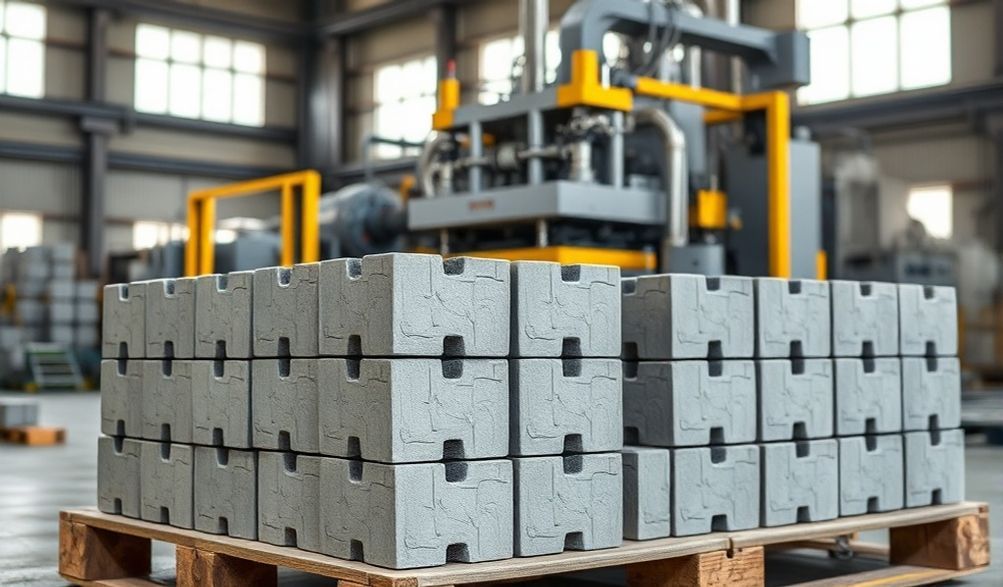
Gid Komplè ou pou Achte Yon Machin pou Fè Blòk Beton ki nan Vann (2024)
Entwodiksyon
Ap bati yon biznis konstriksyon ki pwofitable oswa ogmante kapasite pwodiksyon ou? Bon machin pou fè blòk beton se envestisman ki pi enpòtan ou. Se motè operasyon ou a, li detèmine pwodiksyon ou, kalite pwodwi ou, epi finalman, benefis ou. Men, navige nan vaste mache machin ki pou vann ka yon travay ki difisil, plen ak tèm teknik ak gwo risk finansye.
Gid konplè sa a pou 2024 la, ki baze sou plizyè deseni eksperyans nan endistri a, ap sèvi kòse wout ou ki serye. Nou pral senplifye konpleksite a pou ede w konprann egzakteman sa pou w chèche nan yonmachin pou fè blòk beton pou vannOu pral aprann ki jan pou matche kalite machin ak objektif espesifik ou yo, dekode faktè pri yo, evalye manifaktirè yo ak yon je kritik, epi evite pièj komen ki koute chè. Nan fen an, ou pral ekipe pou pran yon desizyon acha enfòme ak konfyans ki pral alimente kwasans ou pou ane ki vini yo.
Konprann Machin pou Fè Blòk Beton: Kalite ak Aplikasyon yo
Anvan nou plonje nan espesifikasyon ak pri, li enpòtan pou nou konprann kategori fondamantal machin ki disponib yo. Bon chwa a depann de echèl pwodiksyon ou, bidjè ou, ak estrateji travay ou.
Manchèl vs. Semi-Otomatik vs. Otomatik Nèt Machin Blòk
Nivo otomatizasyon se prensipal diferansyatè nan machin blòk, ki afekte dirèkteman pwodiksyon, depans pou travay, ak envestisman inisyal.
-
Machin pou Fè Blòk Manyèl:
- Operasyon:Konplètman moun ki fè travay la. Operatè yo manyèlman ranpli moul la, konprese beton an (souvan avèk yon levye), epi retire blòk la nan moul la.
- Travay & Pwodiksyon:Entansite travay segondè, pwodiksyon trè ba (tipikman 100-500 blok pa jou). Apwopriye pou 1-2 operatè.
- Rekòmandasyon Ekspè:Ideal pou ti antrepriz ki nan yon echèl trè piti, pwojè kominotè, oswa nan zòn izole kote genyen disponiblite fèblès ak kapital ki ba. Yo se yon pwen antre ki genyen risk ki ba, men yo pa apwopriye pou pwodiksyon nan volim komèsyal.
-
Machin Semi-Otomatik pou Fè Blòk:
- Operasyon:Mekanize pwosesis konpakte debaz la (atravè vibrasyon ak presyon idwolik) men li mande pou materyo anvan yo manchman ak retire/anbalaj blòk ki fini yo fèt a men.
- Travay & Pwodiksyon:Demann travay modere (2 a 4 moun), bon pwodiksyon (1,000 a 6,000+ blòk pou chak ekipman 8 èdtan, selon modèl la).
- Rekòmandasyon Ekspè:Pwen ki pi apwopriye pou pifò antrepriz ti a mwayen. Yo ofri yon bon balans ant pri abòdab, amelyorasyon nan pousantaj pwodiksyon, ak konsistans nan kalite blòk. Pafè pou biznis ki ap chèche grandi soti nan operasyon manyèl.
-
Machin Pou Fè Blòk Otomatik Nèt:
- Operasyon:Otomatize nèt atravè sistèm PLC (Kontwolè Lojik Pwogramab). Yo genyen charjman materyèl otomatik, moulaj, konpakte, trete, ak anpile. Souvan fè pati yon liy pwodiksyon konplè.
- Travay & Pwodiksyon: Travay minim (pou sipèvizyon ak antretyen), pwodiksyon anpil (8,000 a 20,000+ blòk pa chanjman).
- Rekòmandasyon Ekspè: Rezève pou plant komèsyal gwo echèl ak kontra gwo volim. Envestisman kapital la jistifye pa efikasite san parèy, pri ki pi ba pou chak inite, ak konsistans siperyè. Bezwen kouran elektrik serye ak pi bon antretyen.
Machin pou Fè Blòk Estasyonè kont Machin pou Fè Blòk Mobil
Diferans sa a gen rapò ak mobilite machin nan ak anprint enstalasyon li.
-
Machin pou fè blòk estasyonè:
- Sa yo se enstalasyon fiks, anjeneral monte sou yon fondasyon konkrè solid nan yon faktori oswa lakou espesyalize.
- Yo jeneralman pi solid, pi pwisan, epi kapab pi gwo volim pwodiksyon.
- Aplikasyon:Chwa estanda pou faktori blòk pèmanan ki apwovizyone yon mache rejyonal.
-
Machin Fè Blòk Mobil (oswa "Pon-yo"):
- Inite sa yo monte sou wou oswa yon trelè. Yo pwodui blòk dirèkteman atè a oswa sou yon dal beton, epi yo avanse pou poze pwochen pakèt la.
- Yo yo senp, souvan mande mwen fondasyon mwens travay, epi yo fasil pou deplase.
- Aplikasyon:Ekselàn pou pwodiksyon sou plas gwo pwojè konstriksyon (tankou bati yon konplèks lojman) kote transpò blòk yo koute chè. Yo elimine domaj ak depans transpò yo.
Pwodwi kle: Kisa ou ka fabrike?
Potansyèl biznis ou a pa limite a blòk estanda. Vèsatilite machin nan, ki detèmine pa sistèm mwazi li a, defini katalòg pwodwi ou yo.
- Blòk vid:Pwodwi ki pi komen pou konstriksyon, ki ofri bon rapò fòs ak pwa ak izolasyon.
- Blòk Solid:Itilize pou aplikasyon ki pòte chay lou ak pave.
- Dale ak Pave Antrebloke: Pou antre kay, chemèn, ak teras. Yon mache ki gen gwo demann nan jaden flè ak travay minisipal.
- Rebò ak Bòdaj Wout: Essential for road construction and landscaping projects.
- Fòm Espesyal: Interlocking blocks for retaining walls, chimney blocks, and decorative landscaping units.
Ekspè Enspirasyon: When evaluating a machin pou fè blòk beton pou vann, inquire about the mold compatibility and cost. A machine that allows for quick mold changes with a wide range of available mold designs enables you to pivot with market demands and capture diverse revenue streams.
Faktè Enpòtan Pou Konsidere Anvan Ou Achte
Armed with an understanding of machine types, you must now drill down into the specifics that separate a wise investment from a costly mistake.
Kapasite Pwodiksyon ak Kondisyon pou Pwodiksyon
Don’t just look at the “maximum” output in a brochure. Think practically.
- Cycles per Hour & Blocks per Cycle: Multiply these figures to get the theoretical hourly output. A machine with a 10-second cycle time producing 4 blocks per cycle can theoretically make 1,440 blocks per hour.
- Real-World Calculation: Deduct time for mold changes, maintenance breaks, material loading delays, and operator shifts. A realistic daily output is often 70-80% of the theoretical maximum.
- Matching to Goals: Align the machine’s realistic output with your current orders and projected growth for the next 3-5 years. Buying slightly more capacity than you need today is often smarter than outgrowing a machine too quickly.
Machine Specifications & Technical Details
These are the nuts and bolts that determine performance and longevity.
- Presyon (Tonaj): Higher compaction pressure (measured in tons) generally produces denser, stronger blocks. For standard hollow blocks, machines range from 50 to 400+ tons.
- Egzijans Pouvwa: Manuals may need no power, while semi-automatics often use a standard 3-phase motor (e.g., 380V/50Hz or 440V/60Hz). Verify your local power supply.
- Sistèm Vibration: This is critical for compacting the concrete and releasing air bubbles. Look for durable, high-frequency vibrators mounted effectively within the mold table.
- Sistèm Kontwòl: From simple relay logic to touch-screen PLCs. More advanced controls offer precision, diagnostic tools, and easier operation.
- Trust Factor: Always ask about the availability of technical manuals, wiring diagrams, and spare parts lists. A supplier’s reluctance to provide these is a major red flag.
Quality of Construction & Key Components
This is where “you get what you pay for” becomes starkly real.
- Kad ak Estrikti: The frame should be made from heavy-duty, reinforced steel plate to withstand constant vibration and pressure without warping.
- Sistèm Idwolik: The heart of an automatic machine. Look for reputable component brands (e.g., Bosch Rexroth, Parker, Yuken) and a well-designed, accessible system with proper filtration and cooling.
- Mwayo: These are high-wear items. They should be made from hardened, high-chrome steel for longevity and precise block dimensions.
- Authoritative Benchmark: Reputable manufacturers will often build to recognized standards (like ISO) and can provide material certificates for critical components. Don’t hesitate to ask for them.
Space, Logistics, and Foundation Needs
A machine isn’t just the machine itself.
- Factory Space: You need space for the machine, raw material storage (aggregates, cement), a mixing area, a curing area, and finished product storage. Include space for forklift movement.
- Foundation: Most stationary machines require a solid, level concrete foundation of specified thickness to absorb vibrations. The supplier should provide detailed foundation drawings.
- Logistics: Consider the machine’s shipping dimensions and weight. Do you have access for a delivery truck? Do you need a crane or heavy forklift for unloading and placement?
Navigating the Market: Cost, Suppliers, and Selection
This is the phase where due diligence separates successful buyers from regretful ones.
Concrete Block Making Machine Price Ranges
Prices vary astronomically based on the factors we’ve discussed. Here’s a transparent 2024 overview:
- Machin Manyèl: $1,000 – $5,000 USD.
- Machin Semi-Otomatik: $8,000 – $50,000+ USD. A robust, mid-capacity model for SME production typically starts around $15,000-$25,000.
- Fully Automatic Machines / Production Lines: $50,000 – $300,000+ USD. Single-pallet fully automatic machines start around $50k-$80k, while large multi-pallet lines with full automation can reach several hundred thousand.
Critical Expertise Note: The initial purchase price is just one part of the Total Cost of Ownership (TCO). A cheaper, poorly supported machine can cost far more in downtime, repair costs, and lost production than a higher-quality, well-supported alternative.
How to Choose a Reputable Manufacturer or Supplier
Your relationship with the supplier is as important as the machine itself. Use this checklist:
- Company History & Reputation: How long have they been in business? Search for their brand name online alongside keywords like “review,” “problem,” or “service.” A 10+ year track record is a good sign.
- Quality Evidence: Do they have quality management certifications (ISO)? Can they provide test reports or videos of the machine in operation? Will they share material certificates for key parts?
- After-Sales Support Structure: This is non-negotiable. Do they have technical support staff? What is the warranty period and what does it cover? Is there a stock of commonly needed spare parts? Do they offer installation supervision and operator training?
- Transparency & References: A trustworthy supplier will be proud to connect you with previous customers in your region or a similar industry. They should also be open to a factory visit or a live video tour of their production facility.
- Drapo Wouj: Extremely low prices, pressure to pay via insecure methods, vague company addresses, inability to communicate clearly in your language, and no physical contact details.
New vs. Used Concrete Block Making Machines
A used machine can be a great value—or a money pit.
- New Machine Pros: Full warranty, latest technology, customized to your needs, reliable performance from day one.
- Used Machine Pros: Lower upfront cost, potential for faster delivery, depreciation already absorbed.
- Used Machine Inspection Checklist:
- Hours/Cycles: Check the machine’s service hour meter or get an estimate of total production cycles.
- Physical Inspection: Look for cracks in the frame, signs of weld repairs, hydraulic oil leaks, and excessive wear on molds and vibrators.
- Test Run: Toujou insist on seeing the machine under power, producing blocks. Listen for unusual noises in the hydraulics or vibrations.
- Documentation: Request the original manuals, part lists, and maintenance history.
Maximizing Your Investment: Operation and Beyond
Your new machine is the centerpiece, but its success depends on the ecosystem around it.
Essential Auxiliary Equipment
Rarely does a machine work in isolation. Consider these for an efficient line:
- Miksè Konkrè: A pan mixer or planetary mixer ensures a consistent, homogenous mix, which is vital for block quality.
- Sistèm Transpòtè Transports mixed concrete to the machine hopper, saving labor and time.
- Sistèm Alimantasyon/Sikilasyon Palèt: Automatic systems move pallets in and out of the machine, crucial for high-output automation.
- Block Curing System: This can be a simple rack system in a sheltered yard or a sophisticated steam curing chamber for faster strength gain.
- Forklift or Block Clamp: Essential for handling raw materials and moving stacks of finished blocks.
Raw Material Considerations for Optimal Blocks
The machine can only form what you feed it.
- Melanj konsepsyon an A proper ratio of cement, sand, aggregate (gravel or crushed stone), and water is critical. The water-cement ratio directly affects strength.
- Aggregate Size: Must be compatible with your mold dimensions—typically between 5mm and 10mm for standard blocks.
- Consistency is Key: Variations in raw material quality or moisture content will lead to inconsistent block density and strength, causing production issues and customer complaints.
The Importance of After-Sales Support
The sale is the beginning of the relationship, not the end.
- Enstalasyon ak Komisyon: Professional setup ensures the machine is level, calibrated, and operating safely from the start.
- Fòmasyon Konplè: Operators must be trained not just on how to run the machine, but on basic troubleshooting, daily maintenance, and safety protocols.
- Warranty & Long-Term Support: Understand the response time for technical queries. How quickly can they ship a critical spare part? A supplier with a strong support network is investing in your long-term success.
Kesyon yo poze souvan (FAQ)
Q: What is the average cost of a concrete block making machine for sale?
A: As detailed above, there’s no single “average.” Prices range from around $1,000 for a basic manual model to well over $200,000 for a high-capacity, fully automatic production line. Your final cost depends on automation level, capacity, brand, and included support.
Q: How many blocks can a standard machine produce per day?
A: Output varies dramatically. A machin semi-otomatik might produce 2,000 to 6,000 standard hollow blocks in an 8-hour shift. A fully automatic single-pallet machine can produce 8,000 to 15,000, while large multi-pallet lines can exceed 20,000 blocks per day.
Q: Can one machine produce different block types and sizes?
A: Yes, absolutely. This is achieved through interchangeable molds. However, factor in the cost of additional molds and the time required for mold changeover, which can temporarily halt production.
Q: What kind of power supply is needed?
A: It depends entirely on the machine. Small manuals may need none. Semi-automatic and automatic machines almost always require a three-phase industrial power supply (commonly 380V/50Hz or 440V/60Hz). Always confirm the exact voltage and power (kW) requirements with the supplier before purchase.
Q: How do I ensure I’m choosing a trustworthy supplier?
A: Follow the checklist in the guide: verify their business history, ask for quality certifications, demand details on after-sales service and spare parts, and always request customer references or a factory visit. A reputable company will be transparent and eager to prove its credibility.
Konklizyon
Purchasing a machin pou fè blòk beton pou vann is a pivotal decision that hinges on careful planning and informed selection. We’ve walked through the essential pillars: defining your production needs and scale, understanding the core differences between manual, semi-automatic, and automatic systems, and prioritizing durable construction and robust after-sales support over price alone.
Remember, this machine is a long-term partner in your business growth. The most cost-effective choice isn’t the cheapest sticker price, but the machine—backed by a reputable supplier—that delivers reliable, efficient production for years with minimal downtime. Thorough research and partnering with experienced, trustworthy experts are the true foundations of your success in the block manufacturing industry.
Ready to take the next step? Browse our curated selection of verified, high-performance concrete block making machines for sale, or contact our team of technical experts today for a free, no-obligation consultation tailored to your project goals.
<