
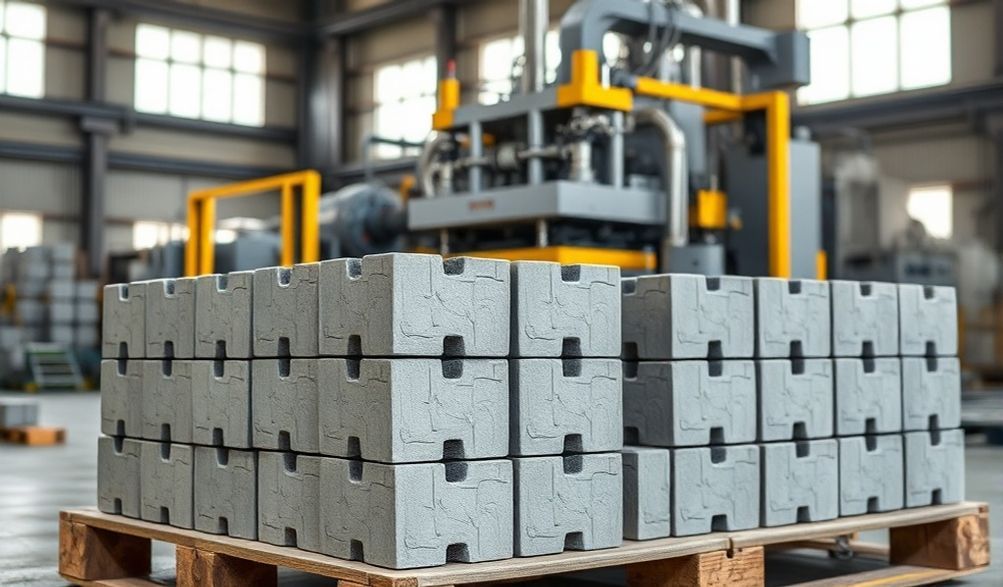
Tu Guía Definitiva para Comprar una Máquina de Hacer Bloques de Concreto en Venta (2024)
Introducción
¿Estás construyendo un negocio de construcción rentable o expandiendo tus capacidades de producción? La máquina adecuada para fabricar bloques de concreto es tu inversión más crítica. Es el motor de tu operación, determinando tu producción, la calidad del producto y, en última instancia, tu rentabilidad. Sin embargo, navegar por el vasto mercado de máquinas en venta puede ser una tarea abrumadora, llena de jerga técnica y riesgos financieros significativos.
Esta completa guía de 2024, basada en décadas de experiencia en la industria, servirá como su hoja de ruta confiable. Atravesaremos la complejidad para ayudarle a entender exactamente qué buscar en unaMáquina para hacer bloques de concreto en ventaAprenderás a elegir los tipos de máquinas según tus objetivos específicos, descifrar los factores de precios, evaluar fabricantes con ojo crítico y evitar errores comunes costosos. Al final, estarás preparado para tomar una decisión de compra informada y segura que impulse tu crecimiento durante años venideros.
Comprensión de las Máquinas para Fabricar Bloques de Concreto: Tipos y Aplicaciones
Antes de adentrarnos en especificaciones y precios, es crucial comprender las categorías fundamentales de máquinas disponibles. La elección correcta depende de su escala de producción, presupuesto y estrategia de mano de obra.
Máquinas de Bloques Manuales vs. Semiautomáticas vs. Automáticas
El nivel de automatización es el principal diferenciador en las máquinas de bloques, impactando directamente la producción, los costos laborales y la inversión inicial.
-
Máquinas Manuales para Fabricar Bloques:
- Operación:Completamente impulsado por humanos. Los operadores llenan manualmente el molde, comprimen el concreto (a menudo mediante una palanca) y desmoldan el bloque.
- Trabajo y Producción:Alta intensidad de mano de obra, producción muy baja (típicamente 100-500 bloques por día). Adecuado para 1-2 operadores.
- Recomendación de Expertos:Ideal para nuevas empresas a muy pequeña escala, proyectos comunitarios o en áreas remotas con baja disponibilidad de energía y capital. Representan un punto de entrada de bajo riesgo, pero no son adecuados para la producción a volumen comercial.
-
Máquinas Semiautomáticas para Fabricar Bloques:
- Operación:Mecaniza el proceso de compactación central (mediante vibración y presión hidráulica), pero requiere alimentación manual de materia prima y retiro/apilado en palets de los bloques terminados.
- Trabajo y Producción:Requerimiento moderado de mano de obra (2 a 4 personas), buena producción (1,000 a 6,000+ bloques por turno de 8 horas, dependiendo del modelo).
- Recomendación de Expertos:El punto ideal para la mayoría de las pequeñas y medianas empresas (PYMES). Ofrecen un excelente equilibrio entre asequibilidad, tasa de producción mejorada y consistencia en la calidad de los bloques. Perfecto para negocios que buscan escalar desde operaciones manuales.
-
Máquinas de Fabricación de Bloques Completamente Automáticas:
- Operación:Completamente automatizado mediante sistemas PLC (Controlador Lógico Programmable). Cuentan con alimentación automática de material, moldeo, compactación, curado y apilado. A menudo forman parte de una línea de producción completa.
- Trabajo y Producción:Mano de obra mínima (para supervisión y mantenimiento), producción muy alta (8.000 a 20.000+ bloques por turno).
- Recomendación de Expertos:Reservado para plantas comerciales de gran escala y contratos de alto volumen. La significativa inversión de capital se justifica por una eficiencia inigualable, un menor costo por unidad y una consistencia superior. Requiere energía confiable y un mantenimiento más sofisticado.
Máquinas Estacionarias para Fabricar Bloques vs. Máquinas Móviles para Bloques
Esta distinción se relaciona con la movilidad de la máquina y su huella de instalación.
-
Máquinas Estacionarias para Fabricar Bloques:
- Estas son instalaciones fijas, típicamente montadas sobre una base sólida de concreto en una fábrica o patio dedicado.
- Generalmente son más robustos, potentes y capaces de mayores volúmenes de producción.
- Aplicación:La opción estándar para plantas de fabricación de bloques permanentes que abastecen un mercado regional.
-
Máquinas Móviles para Fabricar Bloques (o "Ponedoras de Huevos"):
- Estas unidades están montadas sobre ruedas o un remolque. Producen bloques directamente en el suelo o sobre una losa de concreto, luego avanzan para colocar el siguiente lote.
- Son más simples, a menudo requieren menos trabajo de cimentación y son altamente portátiles.
- Aplicación:Excelente para la producción in situ en grandes proyectos de construcción (por ejemplo, construir un complejo de viviendas) donde el transporte de bloques es costoso. Eliminan los daños y costos de transporte.
Productos Clave: ¿Qué Puedes Fabricar?
Tu potencial empresarial no se limita a bloques estándar. La versatilidad de la máquina, determinada por su sistema de moldes, define tu catálogo de productos.
- Bloques Huecos:El producto más común para la construcción, que ofrece una excelente relación resistencia-peso y aislamiento.
- Bloques Sólidos:Usado para aplicaciones de carga pesada y pavimentación.
- Adoquines y Pavimentos Interconectados:Para entradas de vehículos, caminos peatonales y patios. Un mercado de alta demanda en paisajismo y trabajo municipal.
- Bordillos & CéspedEsencial para proyectos de construcción de carreteras y paisajismo.
- Formas Especializadas:Bloques entrelazados para muros de contención, bloques de chimenea y unidades decorativas de paisajismo.
Perspicacia de Expertos:Al evaluar unMáquina para hacer bloques de concreto en ventaConsulte sobre la compatibilidad de moldes y el costo. Una máquina que permita cambios rápidos de molde con una amplia gama de diseños disponibles le permite adaptarse a las demandas del mercado y capturar diversas fuentes de ingresos.
Factores Críticos a Considerar Antes de Comprar
Con un entendimiento de los tipos de máquinas, ahora debes profundizar en los detalles que distinguen una inversión inteligente de un error costoso.
Capacidad de Producción y Requisitos de Producción
Don’t just look at the “maximum” output in a brochure. Think practically.
- Cycles per Hour & Blocks per Cycle: Multiply these figures to get the theoretical hourly output. A machine with a 10-second cycle time producing 4 blocks per cycle can theoretically make 1,440 blocks per hour.
- Real-World Calculation: Deduct time for mold changes, maintenance breaks, material loading delays, and operator shifts. A realistic daily output is often 70-80% of the theoretical maximum.
- Coincidir con los Objetivos: Align the machine’s realistic output with your current orders and projected growth for the next 3-5 years. Buying slightly more capacity than you need today is often smarter than outgrowing a machine too quickly.
Machine Specifications & Technical Details
These are the nuts and bolts that determine performance and longevity.
- Presión (Tonelaje): Higher compaction pressure (measured in tons) generally produces denser, stronger blocks. For standard hollow blocks, machines range from 50 to 400+ tons.
- Requisitos de Energía: Manuals may need no power, while semi-automatics often use a standard 3-phase motor (e.g., 380V/50Hz or 440V/60Hz). Verify your local power supply.
- Sistema de Vibración: This is critical for compacting the concrete and releasing air bubbles. Look for durable, high-frequency vibrators mounted effectively within the mold table.
- Sistema de Control: From simple relay logic to touch-screen PLCs. More advanced controls offer precision, diagnostic tools, and easier operation.
- Trust Factor: Always ask about the availability of technical manuals, wiring diagrams, and spare parts lists. A supplier’s reluctance to provide these is a major red flag.
Quality of Construction & Key Components
This is where “you get what you pay for” becomes starkly real.
- Marco y Estructura: The frame should be made from heavy-duty, reinforced steel plate to withstand constant vibration and pressure without warping.
- Sistema Hidráulico: The heart of an automatic machine. Look for reputable component brands (e.g., Bosch Rexroth, Parker, Yuken) and a well-designed, accessible system with proper filtration and cooling.
- Moldes: These are high-wear items. They should be made from hardened, high-chrome steel for longevity and precise block dimensions.
- Authoritative Benchmark: Reputable manufacturers will often build to recognized standards (like ISO) and can provide material certificates for critical components. Don’t hesitate to ask for them.
Space, Logistics, and Foundation Needs
A machine isn’t just the machine itself.
- Factory Space: You need space for the machine, raw material storage (aggregates, cement), a mixing area, a curing area, and finished product storage. Include space for forklift movement.
- Foundation: Most stationary machines require a solid, level concrete foundation of specified thickness to absorb vibrations. The supplier should provide detailed foundation drawings.
- Logística: Consider the machine’s shipping dimensions and weight. Do you have access for a delivery truck? Do you need a crane or heavy forklift for unloading and placement?
Navigating the Market: Cost, Suppliers, and Selection
This is the phase where due diligence separates successful buyers from regretful ones.
Concrete Block Making Machine Price Ranges
Prices vary astronomically based on the factors we’ve discussed. Here’s a transparent 2024 overview:
- Máquinas Manuales: $1,000 – $5,000 USD.
- Máquinas Semiautomáticas: $8,000 – $50,000+ USD. A robust, mid-capacity model for SME production typically starts around $15,000-$25,000.
- Fully Automatic Machines / Production Lines: $50,000 – $300,000+ USD. Single-pallet fully automatic machines start around $50k-$80k, while large multi-pallet lines with full automation can reach several hundred thousand.
Critical Expertise Note: The initial purchase price is just one part of the Total Cost of Ownership (TCO). A cheaper, poorly supported machine can cost far more in downtime, repair costs, and lost production than a higher-quality, well-supported alternative.
How to Choose a Reputable Manufacturer or Supplier
Your relationship with the supplier is as important as the machine itself. Use this checklist:
- Company History & Reputation: How long have they been in business? Search for their brand name online alongside keywords like “review,” “problem,” or “service.” A 10+ year track record is a good sign.
- Quality Evidence: Do they have quality management certifications (ISO)? Can they provide test reports or videos of the machine in operation? Will they share material certificates for key parts?
- After-Sales Support Structure: This is non-negotiable. Do they have technical support staff? What is the warranty period and what does it cover? Is there a stock of commonly needed spare parts? Do they offer installation supervision and operator training?
- Transparency & References: A trustworthy supplier will be proud to connect you with previous customers in your region or a similar industry. They should also be open to a factory visit or a live video tour of their production facility.
- Red Flags: Extremely low prices, pressure to pay via insecure methods, vague company addresses, inability to communicate clearly in your language, and no physical contact details.
New vs. Used Concrete Block Making Machines
A used machine can be a great value—or a money pit.
- New Machine Pros: Full warranty, latest technology, customized to your needs, reliable performance from day one.
- Used Machine Pros: Lower upfront cost, potential for faster delivery, depreciation already absorbed.
- Used Machine Inspection Checklist:
- Hours/Cycles: Check the machine’s service hour meter or get an estimate of total production cycles.
- Physical Inspection: Look for cracks in the frame, signs of weld repairs, hydraulic oil leaks, and excessive wear on molds and vibrators.
- Test Run: Siempre insist on seeing the machine under power, producing blocks. Listen for unusual noises in the hydraulics or vibrations.
- Documentation: Request the original manuals, part lists, and maintenance history.
Maximizing Your Investment: Operation and Beyond
Your new machine is the centerpiece, but its success depends on the ecosystem around it.
Essential Auxiliary Equipment
Rarely does a machine work in isolation. Consider these for an efficient line:
- Mezcladora de Concreto: A pan mixer or planetary mixer ensures a consistent, homogenous mix, which is vital for block quality.
- Sistema de Transportador: Transports mixed concrete to the machine hopper, saving labor and time.
- Alimentador de Paletas/Sistema de Circulación: Automatic systems move pallets in and out of the machine, crucial for high-output automation.
- Block Curing System: This can be a simple rack system in a sheltered yard or a sophisticated steam curing chamber for faster strength gain.
- Forklift or Block Clamp: Essential for handling raw materials and moving stacks of finished blocks.
Raw Material Considerations for Optimal Blocks
The machine can only form what you feed it.
- Diseño de Mezcla: A proper ratio of cement, sand, aggregate (gravel or crushed stone), and water is critical. The water-cement ratio directly affects strength.
- Aggregate Size: Must be compatible with your mold dimensions—typically between 5mm and 10mm for standard blocks.
- Consistency is Key: Variations in raw material quality or moisture content will lead to inconsistent block density and strength, causing production issues and customer complaints.
The Importance of After-Sales Support
The sale is the beginning of the relationship, not the end.
- Instalación y Puesta en Marcha: Professional setup ensures the machine is level, calibrated, and operating safely from the start.
- Entrenamiento Integral: Operators must be trained not just on how to run the machine, but on basic troubleshooting, daily maintenance, and safety protocols.
- Warranty & Long-Term Support: Understand the response time for technical queries. How quickly can they ship a critical spare part? A supplier with a strong support network is investing in your long-term success.
Frequently Asked Questions (FAQ)
Q: What is the average cost of a concrete block making machine for sale?
A: As detailed above, there’s no single “average.” Prices range from around $1,000 for a basic manual modela más de$200,000 for a high-capacity, fully automatic production line. Your final cost depends on automation level, capacity, brand, and included support.
Q: How many blocks can a standard machine produce per day?
A: Output varies dramatically. A máquina semiautomática might produce 2,000 to 6,000 standard hollow blocks in an 8-hour shift. A fully automatic single-pallet machine can produce 8,000 to 15,000, while large multi-pallet lines can exceed 20,000 blocks per day.
Q: Can one machine produce different block types and sizes?
A: Yes, absolutely. This is achieved through Moldes intercambiables. However, factor in the cost of additional molds and the time required for mold changeover, which can temporarily halt production.
Q: What kind of power supply is needed?
A: It depends entirely on the machine. Small manuals may need none. Semi-automatic and automatic machines almost always require a three-phase industrial power supply (commonly 380V/50Hz or 440V/60Hz). Always confirm the exact voltage and power (kW) requirements with the supplier before purchase.
Q: How do I ensure I’m choosing a trustworthy supplier?
A: Follow the checklist in the guide: verify their business history, ask for quality certifications, demand details on after-sales service and spare parts, and always request customer references or a factory visit. A reputable company will be transparent and eager to prove its credibility.
Conclusión
Purchasing a Máquina para hacer bloques de concreto en venta is a pivotal decision that hinges on careful planning and informed selection. We’ve walked through the essential pillars: defining your production needs and scale, understanding the core differences between manual, semi-automatic, and automatic systems, and prioritizing durable construction and robust after-sales support over price alone.
Remember, this machine is a long-term partner in your business growth. The most cost-effective choice isn’t the cheapest sticker price, but the machine—backed by a reputable supplier—that delivers reliable, efficient production for years with minimal downtime. Thorough research and partnering with experienced, trustworthy experts are the true foundations of your success in the block manufacturing industry.
Ready to take the next step? Browse our curated selection of verified, high-performance concrete block making machines for sale, or contact our team of technical experts today for a free, no-obligation consultation tailored to your project goals.
<