
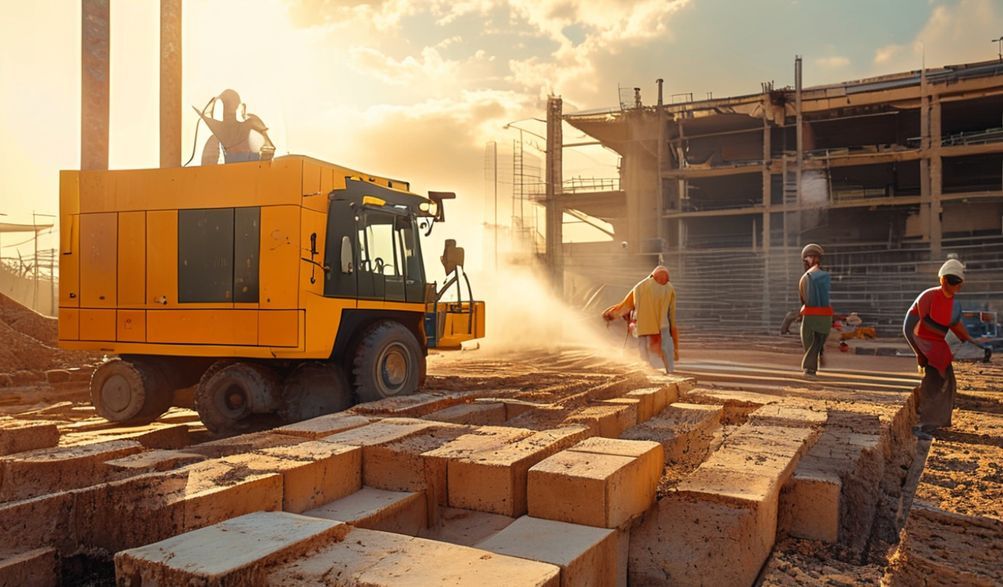
Panduan Utama Anda untuk Mesin Pembuat Blok Dijual di Kenya | Wawasan Pakar dari Kilang FUDA
Pengenalan
Pemandangan langit Kenya sedang berubah. Dari Program Perumahan Mampu Milik yang bercita-cita tinggi hingga pembangunan swasta di pusat bandar yang pesat membangun, permintaan untuk bahan binaan berkualiti tidak pernah lebih tinggi. Di tengah-tengah ledakan pembinaan ini terletak satu komponen kritikal: bata dan blok yang sederhana namun penting. Bagi usahawan, kontraktor, dan firma pembinaan, keputusan untuk melabur dalam mesin pembuat blok bukan sekadar pembelian—ia adalah strategi perniagaan penting yang boleh menentukan keuntungan, kualiti, dan pertumbuhan.
Panduan ini berfungsi sebagai sumber komprehensif dan tidak berat sebelah untuk anda menavigasi pasaran mesin pembuat blok di Kenya. Berdasarkan pengalaman industri yang mendalam dengan piawaian pembuatan global dan pemahaman khusus tentang landskap operasi unik Kenya—dari keadaan tanah yang pelbagai hingga cabaran bekalan kuasa—matlamat kami adalah untuk melengkapkan anda dengan pengetahuan faktual dan praktikal. Kami akan menguraikan jenis mesin yang berbeza, memecahkan kos pemilikan sebenar, dan menyediakan rangka kerja untuk menilai pembekal, termasuk tinjauan terperinci tentang tawaran daripada pengeluar mapan seperti kilang pembuat blok FUDA. Pada akhirnya, anda akan mempunyai peta jalan yang jelas untuk membuat pelaburan yakin dan berinformasi yang membina lebih daripada sekadar dinding; ia membina perniagaan anda.
Memahami Pasaran Mesin Pembuat Blok Kenya
Lonjakan permintaan untuk mesin pembuat blok bukanlah suatu kebetulan. Ia merupakan tindak balas langsung terhadap kuasa ekonomi dan sosial yang kuat yang membentuk negara. Memahami pendorong dan nuansa tempatan ini adalah langkah pertama ke arah pelaburan yang bijak.
Pendorong Pasaran: Mengapa Permintaan Meningkat di Kenya
- Agenda Perumahan Mampu Milik Kerajaan:Projek utama di bawah Agenda Empat Besar ini berfungsi sebagai enjin utama, yang bertujuan menyediakan ratusan ribu unit perumahan. Ini mewujudkan permintaan besar dan berterusan untuk blok berkualiti dan piawai.
- Pembandaran Pesat dan Pembangunan Infrastruktur:Daerah-daerah semakin berkembang, dan bersamanya timbul keperluan untuk rumah baharu, bangunan komersial, jalan raya, dan sekolah. Pengeluaran blok mekanikal adalah kunci untuk memenuhi skala ini dengan cekap.
- Peralihan daripada Pengeluaran Manual kepada Berasaskan Mesin:Terdapat pengakuan yang semakin meningkat bahawa pengeluaran manual adalah satu halangan. Mesin menawarkan konsistensi yang lebih baik, blok yang lebih kuat, dan keupayaan untuk memenuhi tarikh akhir pesanan besar, memberikan kelebihan daya saing kepada perniagaan.
Pertimbangan Utama untuk Konteks Kenya
Membeli mesin yang direka untuk pasaran Eropah tidak menjamin kejayaan di sini. Konteks Kenya memerlukan adaptasi khusus.
- Bahan Mentah Tempatan:Campuran tanah, pasir, dan simen Kenya boleh berbeza dengan ketara mengikut wilayah. Mesin yang berkualiti mesti mempunyai tetapan frekuensi getaran dan tekanan yang boleh dilaraskan untuk memadatkan bahan tempatan ini dengan berkesan, menghasilkan blok yang padat dan kuat setiap kali.
- Bekalan Kuasa:Ketidakstabilan grid di beberapa kawasan merupakan risiko operasi yang nyata. Ini menjadikan ketersediaanenjin berkuasa dieselataumodel hibrid (elektrik/diesel)Ciri penting. Sentiasa nilai kebolehpercayaan kuasa anda dan pilih mesin yang tidak akan terbiar semasa gangguan bekalan elektrik.
- Sokongan Selepas Jualan: This is perhaps the most critical factor. A machine is a long-term asset. You must verify the availability of local technical support, readily available spare parts, and comprehensive operator training. The best machine is useless if it breaks down and stays broken for weeks awaiting a part from overseas.
Types of Block Making Machines: Which One Fits Your Project?
Choosing the right type of machine hinges on your project scale, budget, and output goals. Here’s a breakdown of the most common categories.
Mesin Manual & Semi-Automatik
- Sesuai Untuk: Startups, small-scale builders, community-based projects (CBOs), and those with very low daily output requirements (e.g., under 500 blocks).
- Kelebihan:
- Pelaburan Awal Yang Rendah:Titik kemasukan paling berpatutan ke dalam pengeluaran blok.
- Simplicity & Portability: Easy to operate, maintain, and move around a site.
- Low Power Requirement: Often only needs manual labor or a small mixer.
- Keburukan:
- High Labor Intensity: Requires significant physical effort, limiting output.
- Kualiti Tidak Konsisten: Heavily dependent on operator skill, leading to potential variations in block size and density.
- Output Rendah: Not suitable for commercial supply or medium-to-large projects.
Mesin Stesen Sepenuhnya Automatik
- Sesuai Untuk: Established block yards, suppliers to construction firms, and entrepreneurs targeting the medium-to-high-volume market (e.g., 2,000 to 10,000+ blocks per day).
- Kelebihan:
- High Output & Efficiency: Automated processes (batching, mixing, molding, curing) enable consistent, high-volume production.
- Superior & Consistent Quality: Programmed settings ensure every block meets the same strength and dimensional standard.
- Reduced Labor Costs: Automates the most strenuous tasks, requiring fewer operators for a higher output.
- Keburukan:
- Higher Capital Cost: Requires a more significant upfront investment.
- Requires Stable Setup Space: Needs a dedicated, prepared yard with space for curing and storage.
- Greater Technical Knowledge: Operators need proper training on the control systems and maintenance routines.
Mobile Block Machines (Egg Layers)
- Sesuai Untuk: Large-scale construction projects (like a new school or housing estate) where producing blocks directly on-site eliminates substantial transport costs.
- Kelebihan:
- Excellent Mobility: Can be towed to different locations on a project site as needed.
- Cost-Effective for On-Site Work: Saves up to 30% or more on logistics by curing and using blocks where they are made.
- Simpler than Full Plants: Easier to set up and operate than a full stationary plant.
- Keburukan:
- Output Rendah: Generally produces fewer blocks per hour than a large stationary automatic machine.
- Still Labor-Intensive: Often requires manual feeding and block removal, though more efficient than purely manual methods.
Spotlight: Evaluating FUDA Block Making Machines for the Kenyan Market
As you research, you’ll encounter various brands. FUDA is one established global manufacturer whose machines are available in Kenya. A balanced, informed evaluation is key.
Gambaran Keseluruhan FUDA sebagai Pengilang
FUDA is a Chinese heavy machinery manufacturer with a significant global footprint in construction equipment, including concrete block making machines. They offer a range of models, from semi-automatic to fully automatic stationary plants and mobile egg layers. Their reputation is built on providing a balance of capability and cost-effectiveness. For the Kenyan market, models that emphasize durability and adaptability to local conditions are most relevant.
Key Features to Scrutinize in a FUDA Machine
If considering a FUDA machine, move beyond the brochure. Inspect these critical aspects:
- Kualiti Binaan & Ketahanan: Examine the steel frame thickness and the robustness of the vibration system. High-frequency, high-amplitude vibration motors are essential for compacting Kenyan raw materials into strong blocks. Ask about the grade of steel used in the mold and press head—these are high-wear parts.
- Production Capacity & Versatility: Don’t just look at the “blocks per hour” for a standard hollow block. Verify what other products the machine can produce with a simple mold change—interlocking blocks, paving slabs, kerbstones, etc. Versatility future-proofs your investment against market shifts.
- Automation Level & Ease of Use: Understand the control system. Is it a simple button panel or a programmable logic controller (PLC)? A PLC offers more precision but may require more skilled maintenance. Ask about the daily and weekly maintenance routine—is it straightforward for your team to perform?
The Critical Importance of Local Dealer & Support
This point cannot be overstated. The FUDA machine you buy is only as reliable as the Kenyan dealer who sells and supports it.
- Verify the dealer has a physical workshop and showroom.
- Check their inventory of common spare parts (like vibration motors, seals, and mold liners). Long lead times for parts cripple production.
- Insist on details about their technical team. Are they factory-trained? Can they provide on-site installation and training?
- Mintacontactable references from other local businesses who have purchased from them.
The Real Cost of Owning a Block Making Machine in Kenya
The purchase price is just the beginning. A savvy buyer plans for the Total Cost of Ownership (TCO).
Upfront Purchase Price vs. Total Investment
The initial outlay includes several components:
* Ex-Works Machine Price: The base cost from the factory or local stockist.
* Penghantaran & Logistik: Cost of transport to Mombasa port and then to your yard.
* Customs Duty & Taxes: Budget approximately 25-35% of the CIF value for import duty, VAT, and other levies. Consult a clearing agent for an exact estimate.
* Pemasangan & Pentauliahan: Some suppliers include this; others charge extra. Factor in costs for a level concrete foundation for stationary machines.
Pecahan Kos Operasi
Your ongoing expenses determine profitability:
* Bahan Mentah: Cement, sand, ballast, and water. The machine’s efficiency (waste percentage) directly impacts this cost.
* Buruh: Wages for operators, mixers, and those handling cured blocks.
* Power/Fuel: Electricity consumption for electric motors or diesel costs for engine-driven models.
* Penyelenggaraan & Pembaikan: Regular servicing, replacement of wear parts (molds, pallets), and unexpected repairs. A machine with good local support minimizes downtime costs.
Calculating Your Return on Investment (ROI)
A simple framework to estimate viability:
1. Calculate Total Investment: Sum all upfront costs (A).
2. Estimate Monthly Operational Cost: Add up all ongoing expenses (B).
3. Determine Monthly Revenue: (Monthly block output) x (Selling price per block) = (C).
4. Monthly Profit: C – B = D.
5. Break-Even Point (Months): A / D.
Contoh: If your total investment is KES 2,000,000 and your monthly profit is KES 200,000, your simple payback period is 10 months. Always use conservative estimates for output and price.
A Step-by-Step Buyer’s Checklist
Follow this actionable plan to avoid costly mistakes.
Before You Contact a Seller (Needs Assessment)
Answer these questions first:
* What is my target daily output in blocks?
* What types of blocks do my target customers need? (Hollow, solid, interlocking, paving?)
* What is my total budget, including shipping, taxes, and installation?
* What are my site conditions? (Space, power access, raw material source?)
Questions to Ask Every Supplier (Including FUDA Dealers)
Arm yourself with this list:
* “What is the exact warranty period and what does it cover? Is it handled locally or from abroad?”
* “Can you provide comprehensive operator training on-site?”
* “May I have a list of 3-5 local clients I can visit or call for a reference?”
* “What is your standard lead time for critical spare parts? Do you stock them here in Kenya?”
* “What is included in the delivery price? (FOB, CIF, installed?)”
The Site Visit & Machine Test
Never buy blind.
* Insist on seeing a working machine. A video is not enough.
* Ideally, visit a current client’s yard to see the machine in operation and speak candidly with the owner about performance and support.
* If possible, conduct a test production run using a sample of your own raw materials to see the block quality firsthand.
Soalan Lazim (FAQ)
Q: What is the price range for a good quality block making machine in Kenya?
A: Prices vary dramatically. A simple manual machine can start from KES 150,000, a robust semi-automatic from KES 500,000, while a fully automatic stationary plant can range from KES 2 million to KES 10 million or more. Remember, the cheapest option often carries the highest long-term cost in repairs and downtime.
Q: Can FUDA machines produce interlocking stabilised soil blocks (ISSBs) popular in some Kenyan projects?
A: Producing high-strength ISSBs requires a machine capable of very high compression pressure. While some FUDA models may be adaptable, you must confirm the specific model’s pressure capability (measured in kN or ton-force) with the supplier and likely require a specialized mold. Always request a test with stabilized soil.
Q: How do I ensure I’m dealing with a legitimate supplier and not a scam?
A: 1) Visit their physical office and workshop. 2) Verify their registration with the Business Registration Service. 3) Demand and actually contact client references. 4) Be wary of prices that seem too good to be true. 5) Never make full payment upfront before delivery and installation. Use secure payment methods.
Q: What is the typical lead time from order to installation?
A: If the machine is in local stock, it could be 2-4 weeks for delivery and installation. For an ex-factory order from abroad, lead time is typically 60-90 days for manufacturing, plus 30-45 days for shipping and customs clearance. Always get a written timeline in your contract.
Kesimpulan
Choosing the right block making machine is a strategic decision that hinges on a clear understanding of your business goals, a realistic assessment of costs, and, most importantly, the quality of local support available. From manual starters to fully automatic plants, the ideal machine is the one that reliably meets your production targets within your operational context.
Prioritize total value—where quality machinery meets exceptional after-sales service—over the allure of the lowest initial price tag. We encourage you to use the checklist and frameworks provided here as you visit multiple suppliers, inspect machines in operation, and speak with fellow builders.
Ready to take the next step? Use the knowledge in this guide to ask the right questions and evaluate your options thoroughly. For detailed specifications and quotes, engage with reputable local machinery suppliers who have a verifiable track record of supporting their clients in Kenya. Your informed due diligence today is the foundation for a profitable and sustainable business tomorrow.
<