
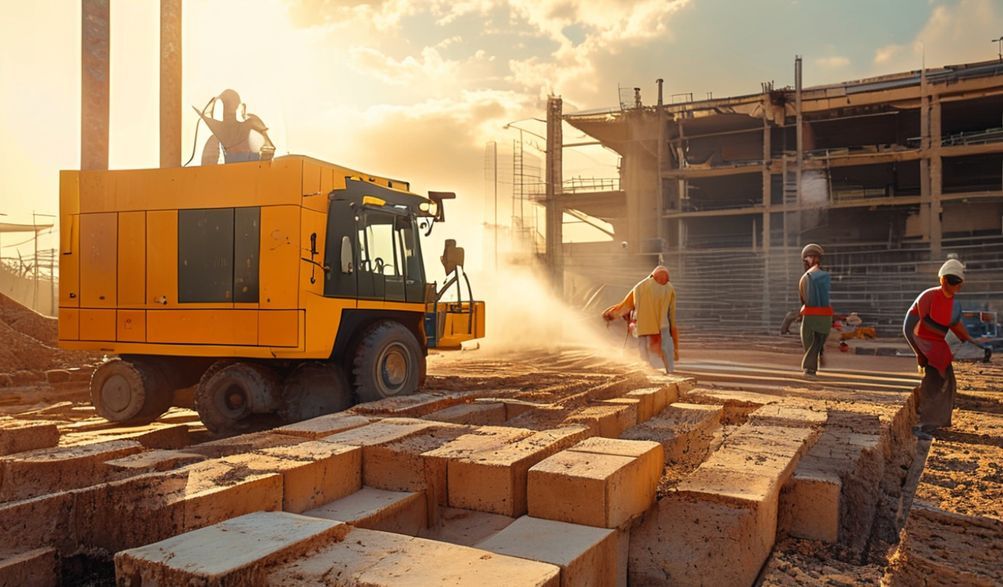
Votre Guide Ultime pour les Machines de Fabrication de Blocs à Vendre au Kenya | Perspectives d'Expert de l'Usine FUDA
Introduction
Le paysage urbain du Kenya est en pleine transformation. Du Programme ambitieux de logements abordables aux développements privés dans les centres urbains en plein essor, la demande en matériaux de construction de qualité n'a jamais été aussi forte. Au cœur de cet essor de la construction se trouve un élément essentiel : la brique et le bloc de construction, modestes mais indispensables. Pour les entrepreneurs, les entrepreneurs généraux et les entreprises de construction, la décision d'investir dans une machine à fabriquer des blocs n'est pas seulement un achat – c'est une stratégie commerciale déterminante qui peut définir la rentabilité, la qualité et la croissance.
Ce guide constitue votre ressource complète et impartiale pour naviguer le marché des machines de fabrication de blocs au Kenya. Fort d'une expérience approfondie de l'industrie, des normes de fabrication mondiales et d'une compréhension spécifique du paysage opérationnel unique du Kenya—des conditions variables des sols aux défis d'alimentation électrique—notre objectif est de vous armer de connaissances factuelles et pratiques. Nous analyserons les différents types de machines, détaillerons le coût réel de possession et fournirons un cadre pour évaluer les fournisseurs, y compris un examen détaillé des offres de fabricants établis comme l'usine de fabrication de blocs FUDA. À la fin, vous disposerez d'une feuille de route claire pour réaliser un investissement éclairé et confiant qui bâtira plus que des murs ; il bâtira votre entreprise.
Comprendre le marché des machines à fabriquer des blocs au Kenya
La montée en flèche de la demande pour les machines de fabrication de blocs n'est pas un hasard. C'est une réponse directe aux puissantes forces économiques et sociales qui façonnent le pays. Comprendre ces moteurs et les nuances locales est la première étape vers un investissement judicieux.
Facteurs de marché : Pourquoi la demande augmente au Kenya
- Programme gouvernemental de logements abordables :Ce projet phare du programme des Quatre Grandes Priorités est un moteur principal, visant à fournir des centaines de milliers de logements. Cela génère une demande massive et soutenue pour des blocs standardisés et de qualité.
- Urbanisation rapide et développement des infrastructures :Les comtés se développent, et avec eux vient le besoin de nouvelles maisons, de bâtiments commerciaux, de routes et d'écoles. La production mécanisée de blocs est essentielle pour répondre à cette échelle efficacement.
- Passage de la production manuelle à la production mécaniséeIl y a une reconnaissance croissante que la production manuelle est un goulot d'étranglement. Les machines offrent une constance supérieure, des blocs plus résistants et la capacité de respecter les délais des grandes commandes, ce qui donne aux entreprises un avantage concurrentiel.
Considérations Clés pour le Contexte Kenyan
Acheter une machine conçue pour le marché européen ne garantit pas le succès ici. Le contexte kényan exige des adaptations spécifiques.
- Matériaux bruts locaux :Les mélanges de sol, de sable et de ciment kényans peuvent varier considérablement selon les régions. Une machine de qualité doit avoir des réglages ajustables de fréquence de vibration et de pression pour compacter efficacement ces matériaux locaux, produisant à chaque fois un bloc dense et solide.
- Alimentation électrique :L'instabilité du réseau dans certaines régions représente un véritable risque opérationnel. Cela rend la disponibilité deMoteurs à moteur dieseloumodèles hybrides (électrique/diesel)Une caractéristique cruciale. Évaluez toujours la fiabilité de votre alimentation électrique et choisissez une machine qui ne restera pas inactive pendant les pannes.
- Support après-vente :C'est peut-être le facteur le plus critique. Une machine est un actif à long terme. Vous devez vérifier la disponibilité dessupport technique local, pièces de rechange facilement disponibles et formation complète des opérateursLa meilleure machine est inutile si elle tombe en panne et reste en panne pendant des semaines en attendant une pièce de l'étranger.
Types de Machines à Blocs : Laquelle Convient à Votre Projet ?
Choisir le bon type de machine dépend de l'ampleur de votre projet, de votre budget et de vos objectifs de production. Voici un aperçu des catégories les plus courantes.
Machines manuelles et semi-automatiques
- Idéal pour :Démarrages, constructeurs à petite échelle, projets communautaires (OBC), et ceux ayant des besoins de production quotidienne très faibles (par exemple, moins de 500 blocs).
- Avantages :
- Faible investissement initial :Le point d'entrée le plus abordable dans la production de blocs.
- Simplicité et portabilité :Facile à utiliser, à entretenir et à déplacer sur un chantier.
- Low Power Requirement: Often only needs manual labor or a small mixer.
- Inconvénients :
- Intensité élevée de la main-d'œuvre : Requires significant physical effort, limiting output.
- Qualité inconstante : Heavily dependent on operator skill, leading to potential variations in block size and density.
- Sortie réduite : Not suitable for commercial supply or medium-to-large projects.
Machines stationnaires entièrement automatiques
- Idéal pour : Established block yards, suppliers to construction firms, and entrepreneurs targeting the medium-to-high-volume market (e.g., 2,000 to 10,000+ blocks per day).
- Avantages :
- High Output & Efficiency: Automated processes (batching, mixing, molding, curing) enable consistent, high-volume production.
- Superior & Consistent Quality: Programmed settings ensure every block meets the same strength and dimensional standard.
- Reduced Labor Costs: Automates the most strenuous tasks, requiring fewer operators for a higher output.
- Inconvénients :
- Higher Capital Cost: Requires a more significant upfront investment.
- Requires Stable Setup Space: Needs a dedicated, prepared yard with space for curing and storage.
- Greater Technical Knowledge: Operators need proper training on the control systems and maintenance routines.
Mobile Block Machines (Egg Layers)
- Idéal pour : Large-scale construction projects (like a new school or housing estate) where producing blocks directly on-site eliminates substantial transport costs.
- Avantages :
- Excellent Mobility: Can be towed to different locations on a project site as needed.
- Cost-Effective for On-Site Work: Saves up to 30% or more on logistics by curing and using blocks where they are made.
- Simpler than Full Plants: Easier to set up and operate than a full stationary plant.
- Inconvénients :
- Sortie réduite : Generally produces fewer blocks per hour than a large stationary automatic machine.
- Still Labor-Intensive: Often requires manual feeding and block removal, though more efficient than purely manual methods.
Spotlight: Evaluating FUDA Block Making Machines for the Kenyan Market
As you research, you’ll encounter various brands. FUDA is one established global manufacturer whose machines are available in Kenya. A balanced, informed evaluation is key.
Aperçu de FUDA en tant que fabricant
FUDA is a Chinese heavy machinery manufacturer with a significant global footprint in construction equipment, including concrete block making machines. They offer a range of models, from semi-automatic to fully automatic stationary plants and mobile egg layers. Their reputation is built on providing a balance of capability and cost-effectiveness. For the Kenyan market, models that emphasize durability and adaptability to local conditions are most relevant.
Key Features to Scrutinize in a FUDA Machine
If considering a FUDA machine, move beyond the brochure. Inspect these critical aspects:
- Qualité de fabrication et durabilité : Examine the steel frame thickness and the robustness of the vibration system. High-frequency, high-amplitude vibration motors are essential for compacting Kenyan raw materials into strong blocks. Ask about the grade of steel used in the mold and press head—these are high-wear parts.
- Production Capacity & Versatility: Don’t just look at the “blocks per hour” for a standard hollow block. Verify what other products the machine can produce with a simple mold change—interlocking blocks, paving slabs, kerbstones, etc. Versatility future-proofs your investment against market shifts.
- Automation Level & Ease of Use: Understand the control system. Is it a simple button panel or a programmable logic controller (PLC)? A PLC offers more precision but may require more skilled maintenance. Ask about the daily and weekly maintenance routine—is it straightforward for your team to perform?
The Critical Importance of Local Dealer & Support
This point cannot be overstated. The FUDA machine you buy is only as reliable as the Kenyan dealer who sells and supports it.
- Verify the dealer has a physical workshop and showroom.
- Check their inventory of common spare parts (like vibration motors, seals, and mold liners). Long lead times for parts cripple production.
- Insist on details about their technical team. Are they factory-trained? Can they provide on-site installation and training?
- Demandercontactable references from other local businesses who have purchased from them.
The Real Cost of Owning a Block Making Machine in Kenya
The purchase price is just the beginning. A savvy buyer plans for the Total Cost of Ownership (TCO).
Upfront Purchase Price vs. Total Investment
The initial outlay includes several components:
* Ex-Works Machine Price: The base cost from the factory or local stockist.
* Expédition et logistique Cost of transport to Mombasa port and then to your yard.
* Customs Duty & Taxes: Budget approximately 25-35% of the CIF value for import duty, VAT, and other levies. Consult a clearing agent for an exact estimate.
* Installation et mise en service : Some suppliers include this; others charge extra. Factor in costs for a level concrete foundation for stationary machines.
Operational Costs Breakdown
Your ongoing expenses determine profitability:
* Matériaux bruts : Cement, sand, ballast, and water. The machine’s efficiency (waste percentage) directly impacts this cost.
* Main-d'œuvre : Wages for operators, mixers, and those handling cured blocks.
* Power/Fuel: Electricity consumption for electric motors or diesel costs for engine-driven models.
* Entretien et réparations : Regular servicing, replacement of wear parts (molds, pallets), and unexpected repairs. A machine with good local support minimizes downtime costs.
Calculating Your Return on Investment (ROI)
A simple framework to estimate viability:
1. Calculate Total Investment: Sum all upfront costs (A).
2. Estimate Monthly Operational Cost: Add up all ongoing expenses (B).
3. Determine Monthly Revenue: (Monthly block output) x (Selling price per block) = (C).
4. Monthly Profit: C – B = D.
5. Break-Even Point (Months): A / D.
Exemple : If your total investment is KES 2,000,000 and your monthly profit is KES 200,000, your simple payback period is 10 months. Always use conservative estimates for output and price.
A Step-by-Step Buyer’s Checklist
Follow this actionable plan to avoid costly mistakes.
Before You Contact a Seller (Needs Assessment)
Answer these questions first:
* What is my target daily output in blocks?
* What types of blocks do my target customers need? (Hollow, solid, interlocking, paving?)
* What is my total budget, including shipping, taxes, and installation?
* What are my site conditions? (Space, power access, raw material source?)
Questions to Ask Every Supplier (Including FUDA Dealers)
Arm yourself with this list:
* “What is the exact warranty period and what does it cover? Is it handled locally or from abroad?”
* “Can you provide comprehensive operator training on-site?”
* “May I have a list of 3-5 local clients I can visit or call for a reference?”
* “What is your standard lead time for critical spare parts? Do you stock them here in Kenya?”
* “What is included in the delivery price? (FOB, CIF, installed?)”
The Site Visit & Machine Test
Never buy blind.
* Insist on seeing a working machine. A video is not enough.
* Ideally, visit a current client’s yard to see the machine in operation and speak candidly with the owner about performance and support.
* If possible, conduct a test production run using a sample of your own raw materials to see the block quality firsthand.
Foire aux questions (FAQ)
Q: What is the price range for a good quality block making machine in Kenya?
A : Prices vary dramatically. A simple manual machine can start from KES 150,000, a robust semi-automatic from KES 500,000, while a fully automatic stationary plant can range from KES 2 million to KES 10 million or more. Remember, the cheapest option often carries the highest long-term cost in repairs and downtime.
Q: Can FUDA machines produce interlocking stabilised soil blocks (ISSBs) popular in some Kenyan projects?
A : Producing high-strength ISSBs requires a machine capable of very high compression pressure. While some FUDA models may be adaptable, you must confirm the specific model’s pressure capability (measured in kN or ton-force) with the supplier and likely require a specialized mold. Always request a test with stabilized soil.
Q: How do I ensure I’m dealing with a legitimate supplier and not a scam?
A : 1) Visit their physical office and workshop. 2) Verify their registration with the Business Registration Service. 3) Demand and actually contact client references. 4) Be wary of prices that seem too good to be true. 5) Never make full payment upfront before delivery and installation. Use secure payment methods.
Q: What is the typical lead time from order to installation?
A : If the machine is in local stock, it could be 2-4 weeks for delivery and installation. For an ex-factory order from abroad, lead time is typically 60-90 days for manufacturing, plus 30-45 days for shipping and customs clearance. Always get a written timeline in your contract.
Conclusion
Choosing the right block making machine is a strategic decision that hinges on a clear understanding of your business goals, a realistic assessment of costs, and, most importantly, the quality of local support available. From manual starters to fully automatic plants, the ideal machine is the one that reliably meets your production targets within your operational context.
Prioritize total value—where quality machinery meets exceptional after-sales service—over the allure of the lowest initial price tag. We encourage you to use the checklist and frameworks provided here as you visit multiple suppliers, inspect machines in operation, and speak with fellow builders.
Ready to take the next step? Use the knowledge in this guide to ask the right questions and evaluate your options thoroughly. For detailed specifications and quotes, engage with reputable local machinery suppliers who have a verifiable track record of supporting their clients in Kenya. Your informed due diligence today is the foundation for a profitable and sustainable business tomorrow.
<