
Le Guide Ultime des Machines à Blocs Creux : Types, Prix et Comment Choisir
Introduction
Des gratte-ciel imposants aux modestes maisons résidentielles, l'environnement bâti moderne repose sur un élément fondamental : le bloc de béton creux. Apprécié pour sa résistance, ses propriétés isolantes et son rapport coût-efficacité, ce matériau de construction omniprésent est l'épine dorsale du secteur de la construction à travers le monde. Mais derrière chaque mur durable se trouve le moteur de sa création : la machine à blocs creux. Pour les entrepreneurs, les entreprises de construction et les investisseurs, choisir la bonne machine est une décision cruciale qui dépend de connaissances techniques, d'une planification financière claire et d'un sens pratique.
Ce guide constitue une ressource complète et impartiale, compilée à partir de spécifications industrielles, de données des fabricants et d'une expertise opérationnelle. Il est conçu pour démystifier le monde de la production de blocs creux. Vous y trouverez une exploration détaillée du fonctionnement de ces machines, une analyse comparative des types disponibles, un aperçu transparent des coûts et des investissements, ainsi que des conseils pratiques sur l'exploitation et la sélection des fournisseurs. Que vous lanciez une entreprise de fabrication de blocs ou que vous vous procuriez des équipements pour un projet majeur, ce guide fournit les connaissances fondamentales nécessaires pour prendre une décision éclairée et en toute confiance.
Qu'est-ce qu'une machine à blocs creux et comment fonctionne-t-elle?
Une machine à blocs creux est un équipement industriel spécialisé conçu pour fabriquer des blocs de béton creux en compactant un mélange de ciment, de granulats et d'eau dans une forme moulée sous une pression et des vibrations importantes.
Fonction principale et sortie : Définition des blocs creux
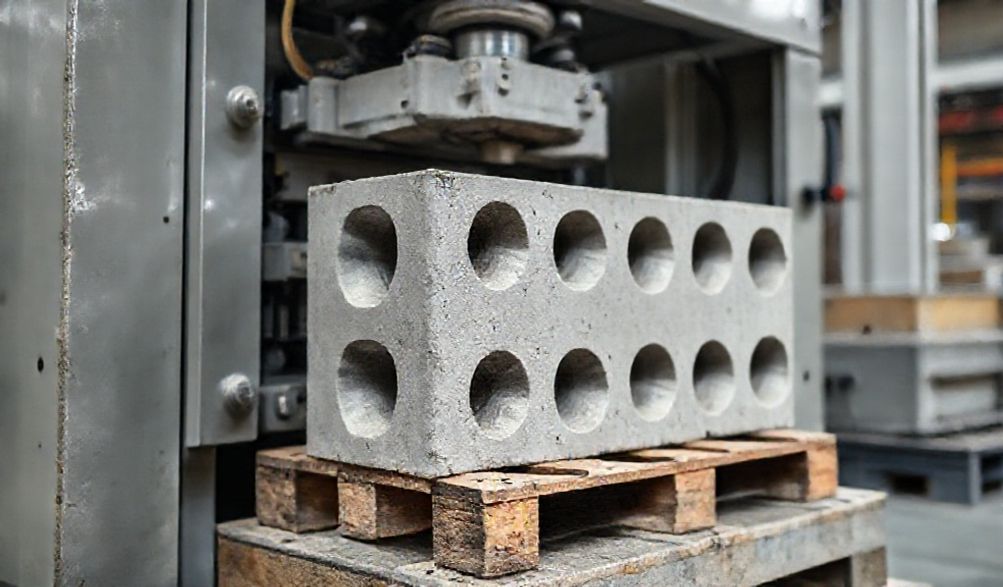
Les blocs de béton creux sont des unités de maçonnerie comportant un ou plusieurs grands trous ou cavités. Ces cavités réduisent le poids global du bloc, améliorent ses propriétés d'isolation thermique et acoustique, et le rendent plus économique en utilisant moins de matière première. Le rôle principal d'une machine à blocs creux est de produire ces blocs de manière constante, efficace et selon une norme structurelle requise. La production de la machine influence directement les délais des projets et la rentabilité de l'entreprise.
Le principe de fonctionnement de base
Le processus de production, bien que variant selon le niveau d'automatisation, suit une séquence d'étapes constante.
- Mélange :Les matières premières (généralement du ciment, du sable, du gravier et de l'eau) sont combinées selon des proportions précises pour former un mélange de béton semi-sec. La consistance est ici cruciale pour la résistance finale des blocs.
- Alimentation :Le béton mélangé est introduit dans la trémie de la machine, qui sert de chambre de retenue et d'entonnoir.
- Compactage et Vibration :C'est le cœur du processus. Le mélange est transféré dans un moule (ou "boîte à moules"). Une combinaison de vibrations haute fréquence et de pression hydraulique compacte le béton, éliminant les poches d'air et garantissant une forme de bloc dense et solide autour des cavités creuses.
- Moulage et Éjection :Une fois compacté, le moule est soulevé ou rétracté, et le nouveau bloc "cru" est éjecté sur une palette ou le sol de l'usine.
- Guérison :Les blocs éjectés n'ont pas encore atteint leur pleine résistance. Ils doivent subir un processus de durcissement, impliquant souvent une humidité et une température contrôlées pendant 24 à 48 heures, avant de pouvoir être empilés, transportés et utilisés dans la construction.
Composants clés d'une machine standard
Comprendre les principales parties clarifie la capacité de la machine et les besoins de maintenance.
- Hopper :Le réceptacle qui contient et alimente le mélange de béton brut dans le système de moulage.
- Mélangeur:Une unité intégrée ou séparée qui assure un mélange homogène de toutes les matières premières.
- Moule / Boîte de mouleL'élément déterminant. Cette boîte en acier interchangeable confère au bloc sa forme, ses dimensions et la conception de sa cavité. Différents moules permettent à une seule machine de produire divers types de blocs.
- Système de Vibration :Habituellement composés de vibrateurs électriques puissants montés sur la table ou la chambre du moule. Une vibration haute fréquence est essentielle pour un compactage adéquat et une finition lisse des blocs.
- Système hydraulique :Le groupe motopompe. Il se compose d'une pompe, de vérins et de vannes qui génèrent l'immense pression (mesurée en tonnes) nécessaire pour comprimer le béton.
- Panneau de configuration :Abrite les systèmes électriques et les interfaces (des leviers simples aux contrôleurs logiques programmables) pour faire fonctionner la machine.
Types de machines à blocs creux : Comparaison détaillée
Choisir le bon type de machine est la décision la plus importante que vous aurez à prendre. Le spectre va des systèmes purement motorisés par l'humain jusqu'aux systèmes entièrement automatisés.
Machines à blocs de béton manuelles
- Opération et sortieIl s'agit de machines purement mécaniques. Les opérateurs remplissent manuellement le moule de béton, actionnent un levier pour appliquer la pression, puis retirent le bloc fini. La production est lente et fortement dépendante de la main-d'œuvre, avec un rendement variant généralement de 500 à 1 500 blocs par quart de travail de 8 heures.
- Avantages et inconvénients :
- Avantages :Investissement initial très faible, conception simple avec un entretien minimal, aucun besoin d’alimentation électrique dans les modèles de base.
- Inconvénients :Extrêmement exigeant en main-d'œuvre, rendement faible et irrégulier, fortement dépendant des compétences de l'opérateur, produit des blocs de qualité variable.
- Idéal pour :Micro-entreprises, projets personnels à très petite échelle ou emplacements éloignés sans alimentation électrique fiable et avec une main-d'œuvre abondante et bon marché.
Machines à blocs de béton creux semi-automatiques
- Opération et sortie This category strikes a balance. Key processes like vibration, compression, and block ejection are powered (electrically or hydraulically), but tasks like feeding raw material and removing finished blocks are often manual. Output can range from 1,500 to 5,000 blocks per shift, depending on model and crew size.
- Avantages et inconvénients :
- Avantages : Significant increase in production and consistency over manual machines. More efficient use of labor, better block quality due to controlled vibration/pressure. Moderate capital cost.
- Inconvénients : Still requires a steady crew, not as fast as fully automatic lines, output can be bottlenecked by manual handling stages.
- Idéal pour : Small to medium-sized block manufacturing businesses, construction companies producing for their own projects, and entrepreneurs making a serious entry into the market.
Machines à blocs creux entièrement automatiques
- Opération et sortie These are integrated production lines. They often include automatic batching and mixing systems, conveyor belts for material feeding, robotic pallet handling, and stackers. Human intervention is primarily for monitoring, maintenance, and quality checks. Output can easily exceed 10,000 blocks per shift and can reach up to 30,000 or more for large systems.
- Avantages et inconvénients :
- Avantages : Maximum production capacity and consistent, high-quality output. Drastically reduced direct labor costs. Highly efficient and scalable for large-volume contracts.
- Inconvénients : Very high initial capital investment. Requires significant space, stable three-phase power, and skilled technicians for maintenance and troubleshooting. Complex setup.
- Idéal pour : Large-scale commercial block yards supplying regional markets, major infrastructure projects with on-site production plants, and established manufacturers expanding capacity.
Machines à blocs fixes vs. mobiles
This is another key distinction based on application:
* Machines stationnaires : These are fixed installations, typically found in a factory or dedicated production shed. They are the foundation for semi- and fully-automatic systems, designed for high-volume, long-term production.
* Machines mobiles : Mounted on a trailer or truck bed, these are designed for on-site production. They eliminate transport costs for blocks and are ideal for large, remote projects like dams, highways, or rural housing developments. They are almost always semi-automatic in function.
Critical Factors to Consider Before Buying a Hollow Block Machine
Moving beyond type, a deep dive into specifications and context is necessary for a sound investment.
Évaluation de vos besoins de production
Begin by asking fundamental questions:
* What is my target output in blocks per hour or per day?
* What specific block sizes, types (e.g., 4″, 6″, 8″ hollow blocks, solid blocks, pavers), and strengths do my customers or projects demand?
* Is this for a fixed factory location or does it need to be mobile for on-site work?
* What is the scale of my business or project? A startup’s needs differ from an expanding enterprise’s.
Spécifications et caractéristiques de la machine
Scrutinize the technical details:
* Capacité de pression (Tonnage) : This directly affects block density and strength. A 150-ton machine produces stronger blocks than a 50-ton machine, all else being equal.
* Système de Vibration : Look for adjustable frequency and amplitude. Multiple vibrators (often 2-4) ensure even compaction.
* Puissance du moteur : Must be adequate to drive the hydraulic pump and vibrators without strain. Underpowered motors will fail prematurely.
* Niveau d'automatisation : Be clear on what is automated. Is it just vibration, or does it include feeding, pallet rotation, and stacking?
* Polyvalence des moules : Check how easily molds can be changed and what range of mold designs the machine’s frame and system can accommodate.
Quality of Construction and Durability
The machine’s build determines its lifespan. Prioritize:
* Qualité d'acier : Main frames and mold boxes should be made from high-grade, wear-resistant steel plate.
* Welding Quality: Inspect for clean, continuous, and robust welds, especially at stress points.
* Component Brands: Reputable machines use known brands for critical parts like hydraulic pumps (e.g., Rexroth, Parker), electrical components (Siemens, Schneider), and bearings.
Supplier Reputation and After-Sales Service
This factor can outweigh a slightly lower price. A common pitfall is choosing a cheap machine with no local support.
* History & Reviews: Research the supplier’s track record. How long have they been in business? Seek out independent client testimonials.
* Garantie : Understand exactly what is covered (parts, labor) and for how long.
* Pièces de rechange : Are spare parts readily available locally or must they be shipped from overseas, causing costly downtime?
* Support technique : Does the supplier offer installation supervision, operator training, and prompt troubleshooting assistance?
Hollow Block Machine Price Range and Investment Analysis
Costs vary dramatically based on type, capacity, brand, and region. The figures below are approximate global ranges for the machine unit only.
Répartition des prix par type de machine
- Machines manuelles pour blocs creux : $1,000 – $5,000 USD. The price depends on build quality and included features.
- Machines à blocs de béton semi-automatiques : $10,000 – $50,000+ USD. This wide range covers small stationary models to large, high-output mobile units.
- Fully Automatic Hollow Block Machines: $50,000 – $300,000+ USD. The price escalates with the level of integration (batching plant, conveyors, robotic stackers).
Crucially, always request detailed quotations from multiple suppliers, as final prices are highly configurable.
Beyond the Machine: Calculating Total Investment
The machine cost is only part of the capital outlay. Budget for:
* Matériaux bruts : Initial stockpile of cement, aggregates (sand, gravel).
* Land & Infrastructure: Cost of land or shed rental, concrete flooring, and a reliable power connection (often three-phase).
* Ancillary Equipment: Forklift or pallet jack, curing racks or chambers, mixing equipment if not integrated.
* Labor & Operating Costs: Wages, electricity, water, and maintenance supplies.
* Maintenance Fund: A reserve for unexpected repairs and spare parts.
Understanding ROI (Return on Investment)
A basic ROI framework involves:
1. Calculate Revenue: (Number of blocks produced per month) x (Selling price per block in your market).
2. Calculate Monthly Operating Costs: Sum of raw material costs, labor, utilities, maintenance, and overheads.
3. Calculate Gross Monthly Profit: Revenue – Operating Costs.
4. Consider Initial Investment: Total cost of machine + setup + other capital expenses.
5. Estimate Payback Period: Initial Investment / Gross Monthly Profit. This gives the number of months to recover your investment.
Remarque : Market demand, operational efficiency, and cost control are the true drivers of profitability. Never rely on a supplier’s generic “guaranteed profit” claims.
Operation, Maintenance, and Safety Best Practices
Proper operation extends machine life and ensures consistent product quality.
Essential Daily and Periodic Maintenance
- Daily: Clean all concrete residue from the mold, hopper, and table. Check hydraulic oil levels and for leaks. Inspect electrical connections for tightness.
- Weekly: Lubricate all moving parts (pivots, guide rods) as per the manual. Tighten any loose bolts or nuts.
- Monthly: Change hydraulic oil and filters as recommended. Inspect mold liners for wear and vibrator mounts for cracks.
A common oversight is neglecting to clean the mold thoroughly, leading to built-up concrete that affects block dimensions and causes sticking.
Common Operational Issues and Troubleshooting
- Poor Block Strength: Usually caused by an incorrect water-cement ratio, insufficient vibration time, or low compaction pressure.
- Surface Cracks: Can result from too much water in the mix, improper curing (drying too fast), or excessive vibration.
- Blocks Sticking in Mold: Often due to a worn or damaged mold liner, insufficient mold release agent, or a wet concrete mix.
- Uneven Block Height: Typically indicates an unlevel machine, uneven feeding of the mold, or worn-out vibration mounts causing uneven compaction.
Non-Negotiable Safety Protocols
- Lockout/Tagout (LOTO): Always disconnect and lock the power source before performing any maintenance or clearing a jam.
- Équipement de protection individuelle (EPI) : Operators must wear safety glasses, hearing protection (due to loud vibrators), heavy-duty gloves, and steel-toe boots.
- Safe Material Handling: Use proper lifting techniques or mechanical aids when handling heavy molds or bags of cement to prevent injury.
Frequently Asked Questions (FAQ) About Hollow Block Machines
What is the average production capacity of a standard hollow block machine?
Capacity is not standard; it’s defined by type. A manual machine may produce 600-800 blocks per day. A semi-automatic machine can produce 2,000-4,000 blocks in an 8-hour shift. A fully automatic line can produce 8,000-15,000 blocks or more in the same period.
Can one machine produce different block sizes and types?
Yes, most machines are designed to work with interchangeable molds. By changing the mold box, the same machine can typically produce different sizes of hollow blocks, solid blocks, paving stones, and curb stones, provided the machine’s pressure and feed system are compatible.
What is the typical lead time for delivery and installation?
For standard models from local stock, delivery can be within weeks. For custom-configured or imported machines, lead times can range from 60 to 120 days. Installation and commissioning by a technician may add additional time.
How much profit can I make from a hollow block business?
Profitability is highly variable and depends on your local market price for blocks, your operational efficiency, raw material costs, and overheads. Focus on controlling your production costs and understanding your local demand. Use the ROI framework provided earlier to model different scenarios based on your specific numbers.
What are the most trusted brands or how do I verify a supplier’s credibility?
Rather than recommending specific brands, which vary by region, focus on verification methods:
1. Request and actually contact client references.
2. Ask to visit an existing installation to see the machine running and speak to the owner.
3. Check for membership in relevant industry associations or possession of quality management certifications (like ISO).
4. Search for independent reviews or complaints about the supplier online.
5. Assess the professionalism and technical depth of their sales and support team.
Conclusion
Selecting a hollow block machine is a strategic investment that requires aligning technology with ambition. The journey begins by honestly assessing your production needs, financial capacity, and market context. From the labor-dependent manual press to the humming fully automatic plant, each machine type serves a distinct purpose.
Remember, the lowest purchase price can often lead to the highest long-term cost through downtime and poor support. Prioritize suppliers who demonstrate proven expertise, offer robust warranties, and have a tangible commitment to after-sales service. The most prudent path forward involves diligent research: visit industry trade shows, consult with established block manufacturers, and obtain multiple detailed quotations. By applying the insights in this guide, you are equipped to make a decision that lays a solid foundation for a profitable, efficient, and sustainable venture in the essential business of building.
<