
Jagorar Cikakke na Injin Hollow Block: Nau'uka, Farashin, da Yadda Ake Zaba
Gabatarwa
Daga manyan gine-ginen sama zuwa gidaje masu sauƙi na zama, muhallin gini na zamani ya dogara ne da wani muhimmin sashi: tubalin siminti mai ramuka. Ana daraja shi saboda ƙarfinsa, kaddarorin rufewa, da tsada mai araha, wannan kayan gini da ake amfani da shi ko'ina shine ginshiƙin gine-gine a duniya. Amma a bayan kowane katanga mai ƙarfi akwai injin da aka ƙirƙira shi—injin tubalin ramuka. Ga 'yan kasuwa, kamfanonin gine-gine, da masu saka hannun jari, zaɓar injin da ya dace yanke shawara ce mai mahimmanci wacce ta dogara ne da ilimin fasaha, tsarin kuɗi mai haske, da fahimta mai amfani.
Wannan jagora ta zama cikakkiyar albarkatu mara son kai, wadda aka tattara daga cikin ƙayyadaddun masana'antu, bayanan masana'anta, da ƙwarewar aiki. An tsara ta ne don bayyana duniyar samar da tubalan gida. A cikinta, za ku sami cikakken bincike kan yadda waɗannan injinan ke aiki, nazarin kwatancen nau'ikan da ake da su, bayyana farashi da saka hannun jari, da kuma shawarwari masu amfani kan aiki da zaɓin masu kaya. Ko kuna ƙaddamar da kasuwancin kera tubalan gida ko kuma nemo kayan aiki don babban aiki, wannan jagora tana ba da ilimin tushe da ake buƙata don yanke shawara cikin masaniya da kwarin gwiwa.
Menene Injin Hollow Block da Yadda Ake Aiki da Ita?
Na'urar yin bulo mai ramuka wata na'ura ce ta musamman da aka ƙera don yin bulo mai ramuka ta hanyar matsawa cakuda siminti, guga, da ruwa zuwa siffar da aka ƙera a ƙarƙashin matsi mai mahimmanci da rawar jiki.
Ayyukan Ciki da Fitowa: Ma'anar Tubalan Ciki
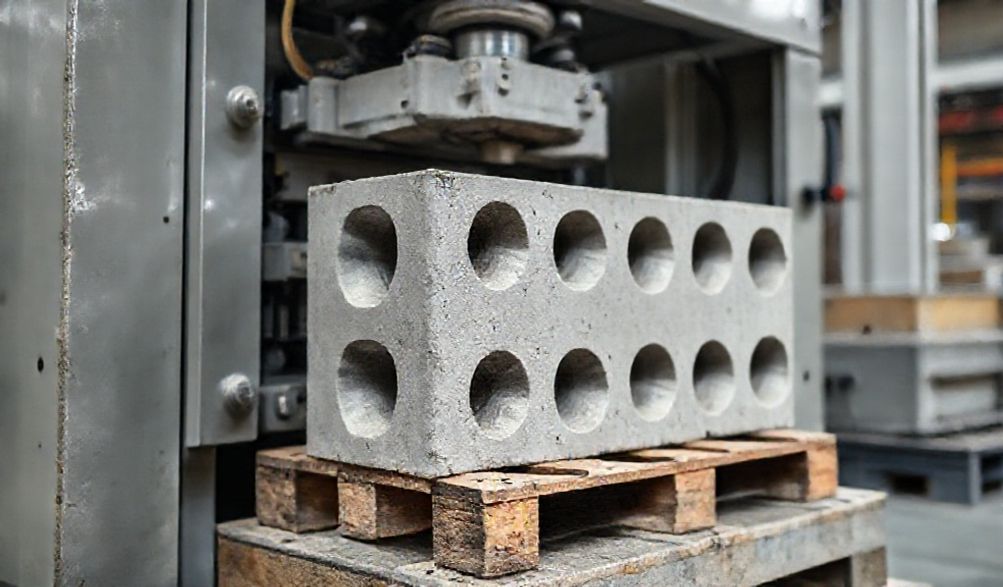
Tubalin cakuɗaɗɗen siminti sune ɓangarorin ginin da ke da ramuka ko kogon ciki guda ɗaya ko fiye. Waɗannan kogayen suna rage nauyin tubalin gabaɗaya, suna inganta kaddarorin rufewar zafi da sauti, kuma suna sa ya fi arha ta hanyar amfani da ƙarancin albarkatun ƙasa. Babban aikin injin yin tubalin cakuɗaɗɗe shi ne samar da waɗannan tubalin akai-akai, cikin inganci, da kuma bisa ƙa'idar gini da ake buƙata. Abin da injin ya samar yana shafar tsarin lokutan aikin da ribar kasuwancin kai tsaye.
Tsarin Aiki na Asali
Tsarin samarwa, ko da yake ya bambanta bisa matakin sarrafa kansa, yana bin jerin matakai masu daidaito:
- Haɗawa:Kayan aiki (galibin siminti, yashi, tsakuwa, da ruwa) ana haɗa su cikin ma'auni masu daidaito don samar da cakuda siminti mai ɗan bushewa. Daidaitaccen yanayi yana da mahimmanci ga ƙarfin tubalin ƙarshe.
- Ciyarwa:Simintin da aka haɗa ana shigar da shi cikin maƙarƙashiyar na'urar, wanda ke aiki azaman ɗakin riƙewa da kuma tacewa.
- Ƙaddamarwa da Girgizawa:Wannan shi ne tsakiyar tsari. Ana canza cakuda zuwa wani ginshiƙi (ko "akwatin ginshiƙi"). Haɗakar girgizar mai ƙarfi da matsa lamba na hydraulic suna matsar da simintin, suna kawar da iska kuma suna tabbatar da ƙaƙƙarfan siffar bulo mai ƙarfi a kusa da ramukan da ba su da tushe.
- Gyare-gyare da Fitowa:Da zarar an matsa, ana ɗaga ko jawo ginshiƙin, sannan a fitar da sabon tubalin “kore” a kan pallet ko kuma ɗakin masana'anta.
- Maganin Ciwon Ciki:Tubalan da aka fitar ba su da cikakken ƙarfi tukuna. Dole ne su sha fama da tsarin warkewa, sau da yawa suna haɗa da sarrafa danshi da zafin jiki na tsawon sa'o'i 24-48, kafin a iya tattara su, jigilar su, da amfani da su a ginin.
Abubuwan Muhimman na Injin Daidaitacce
Understanding the main parts clarifies machine capability and maintenance needs:
- Hopper: The receptacle that holds and feeds the raw concrete mix into the molding system.
- Mixer: An integrated or separate unit that ensures a homogeneous blend of all raw materials.
- Mold / Akwatin Gyare-gyare: The defining component. This interchangeable steel box gives the block its shape, size, and cavity design. Different molds allow one machine to produce various block types.
- Tsarin Girgiza: Usually comprised of powerful electric vibrators mounted on the mold table or chamber. High-frequency vibration is essential for proper compaction and a smooth block finish.
- Tsarin Hydraulic: The powerhouse. It consists of a pump, cylinders, and valves that generate the immense pressure (measured in tons) needed to compress the concrete.
- Kwamitin Sarrafawa: Houses the electrical systems and interfaces (from simple levers to programmable logic controllers) for operating the machine.
Types of Hollow Block Machines: A Detailed Comparison
Choosing the correct type of machine is the most significant decision you will make. The spectrum ranges from purely human-powered to fully automated systems.
Matsarorin Hollow Block na Hannu
- Aiki & Fitarwa These are purely mechanical machines. Operators manually fill the mold with concrete, engage a lever to apply pressure, and then remove the finished block. Production is slow, heavily reliant on labor, with an output typically ranging from 500 to 1,500 blocks per 8-hour shift.
- Abubuwan Da Suke Da Kyau Da Kuma Wadanda Ba Su Da Kyau:
- Abubuwan da suka fi kyau: Very low initial investment, simple design with minimal maintenance, no need for electrical power in basic models.
- Rashin Kyau: Extremely labor-intensive, low and inconsistent output, highly dependent on operator skill, produces blocks of variable quality.
- Mafi Kyau Don: Micro-enterprises, very small-scale personal projects, or remote locations with no reliable power supply and abundant cheap labor.
Injin Ƙirƙirar Tubalan Ciki Wofi na Rago-da-kai
- Aiki & Fitarwa This category strikes a balance. Key processes like vibration, compression, and block ejection are powered (electrically or hydraulically), but tasks like feeding raw material and removing finished blocks are often manual. Output can range from 1,500 to 5,000 blocks per shift, depending on model and crew size.
- Abubuwan Da Suke Da Kyau Da Kuma Wadanda Ba Su Da Kyau:
- Abubuwan da suka fi kyau: Significant increase in production and consistency over manual machines. More efficient use of labor, better block quality due to controlled vibration/pressure. Moderate capital cost.
- Rashin Kyau: Still requires a steady crew, not as fast as fully automatic lines, output can be bottlenecked by manual handling stages.
- Mafi Kyau Don: Small to medium-sized block manufacturing businesses, construction companies producing for their own projects, and entrepreneurs making a serious entry into the market.
Injinoyin Hollow Block Masu Sarrafa Kansu Gabaɗaya
- Aiki & Fitarwa These are integrated production lines. They often include automatic batching and mixing systems, conveyor belts for material feeding, robotic pallet handling, and stackers. Human intervention is primarily for monitoring, maintenance, and quality checks. Output can easily exceed 10,000 blocks per shift and can reach up to 30,000 or more for large systems.
- Abubuwan Da Suke Da Kyau Da Kuma Wadanda Ba Su Da Kyau:
- Abubuwan da suka fi kyau: Maximum production capacity and consistent, high-quality output. Drastically reduced direct labor costs. Highly efficient and scalable for large-volume contracts.
- Rashin Kyau: Very high initial capital investment. Requires significant space, stable three-phase power, and skilled technicians for maintenance and troubleshooting. Complex setup.
- Mafi Kyau Don: Large-scale commercial block yards supplying regional markets, major infrastructure projects with on-site production plants, and established manufacturers expanding capacity.
Stationary vs. Mobile Block Making Machines
This is another key distinction based on application:
* Injinon Ƙayyadaddun Wuri: These are fixed installations, typically found in a factory or dedicated production shed. They are the foundation for semi- and fully-automatic systems, designed for high-volume, long-term production.
* Na'urorin Motsi: Mounted on a trailer or truck bed, these are designed for on-site production. They eliminate transport costs for blocks and are ideal for large, remote projects like dams, highways, or rural housing developments. They are almost always semi-automatic in function.
Critical Factors to Consider Before Buying a Hollow Block Machine
Moving beyond type, a deep dive into specifications and context is necessary for a sound investment.
Ƙididdige Bukatun Samarwa
Begin by asking fundamental questions:
* What is my target output in blocks per hour or per day?
* What specific block sizes, types (e.g., 4″, 6″, 8″ hollow blocks, solid blocks, pavers), and strengths do my customers or projects demand?
* Is this for a fixed factory location or does it need to be mobile for on-site work?
* What is the scale of my business or project? A startup’s needs differ from an expanding enterprise’s.
Ƙayyadaddun Na'ura da Fasali
Scrutinize the technical details:
* Ƙarfin Matsi (Tona): This directly affects block density and strength. A 150-ton machine produces stronger blocks than a 50-ton machine, all else being equal.
* Tsarin Girgiza: Look for adjustable frequency and amplitude. Multiple vibrators (often 2-4) ensure even compaction.
* Ƙarfin Motar: Must be adequate to drive the hydraulic pump and vibrators without strain. Underpowered motors will fail prematurely.
* Matsayin Sarrafa Kansa: Be clear on what is automated. Is it just vibration, or does it include feeding, pallet rotation, and stacking?
* Yawan Amfani da Molds: Check how easily molds can be changed and what range of mold designs the machine’s frame and system can accommodate.
Quality of Construction and Durability
The machine’s build determines its lifespan. Prioritize:
* Ƙarfen Ƙarfe: Main frames and mold boxes should be made from high-grade, wear-resistant steel plate.
* Welding Quality: Inspect for clean, continuous, and robust welds, especially at stress points.
* Component Brands: Reputable machines use known brands for critical parts like hydraulic pumps (e.g., Rexroth, Parker), electrical components (Siemens, Schneider), and bearings.
Supplier Reputation and After-Sales Service
This factor can outweigh a slightly lower price. A common pitfall is choosing a cheap machine with no local support.
* History & Reviews: Research the supplier’s track record. How long have they been in business? Seek out independent client testimonials.
* Warranty: Understand exactly what is covered (parts, labor) and for how long.
* Kayan Gyara: Are spare parts readily available locally or must they be shipped from overseas, causing costly downtime?
* Tallafin Fasaha: Does the supplier offer installation supervision, operator training, and prompt troubleshooting assistance?
Hollow Block Machine Price Range and Investment Analysis
Costs vary dramatically based on type, capacity, brand, and region. The figures below are approximate global ranges for the machine unit only.
Price Breakdown by Machine Type
- Motinan Hollow Block: $1,000 – $5,000 USD. The price depends on build quality and included features.
- Injinoyin Hollow Block Masu Sarrafa Kansu: $10,000 – $50,000+ USD. This wide range covers small stationary models to large, high-output mobile units.
- Fully Automatic Hollow Block Machines: $50,000 – $300,000+ USD. The price escalates with the level of integration (batching plant, conveyors, robotic stackers).
Crucially, always request detailed quotations from multiple suppliers, as final prices are highly configurable.
Beyond the Machine: Calculating Total Investment
The machine cost is only part of the capital outlay. Budget for:
* Kayan Aiki: Initial stockpile of cement, aggregates (sand, gravel).
* Land & Infrastructure: Cost of land or shed rental, concrete flooring, and a reliable power connection (often three-phase).
* Ancillary Equipment: Forklift or pallet jack, curing racks or chambers, mixing equipment if not integrated.
* Labor & Operating Costs: Wages, electricity, water, and maintenance supplies.
* Maintenance Fund: A reserve for unexpected repairs and spare parts.
Understanding ROI (Return on Investment)
A basic ROI framework involves:
1. Calculate Revenue: (Number of blocks produced per month) x (Selling price per block in your market).
2. Calculate Monthly Operating Costs: Sum of raw material costs, labor, utilities, maintenance, and overheads.
3. Calculate Gross Monthly Profit: Revenue – Operating Costs.
4. Consider Initial Investment: Total cost of machine + setup + other capital expenses.
5. Estimate Payback Period: Initial Investment / Gross Monthly Profit. This gives the number of months to recover your investment.
Note: Market demand, operational efficiency, and cost control are the true drivers of profitability. Never rely on a supplier’s generic “guaranteed profit” claims.
Operation, Maintenance, and Safety Best Practices
Proper operation extends machine life and ensures consistent product quality.
Essential Daily and Periodic Maintenance
- Kullum: Clean all concrete residue from the mold, hopper, and table. Check hydraulic oil levels and for leaks. Inspect electrical connections for tightness.
- Mako-mako: Lubricate all moving parts (pivots, guide rods) as per the manual. Tighten any loose bolts or nuts.
- Kowane wata: Change hydraulic oil and filters as recommended. Inspect mold liners for wear and vibrator mounts for cracks.
A common oversight is neglecting to clean the mold thoroughly, leading to built-up concrete that affects block dimensions and causes sticking.
Common Operational Issues and Troubleshooting
- Poor Block Strength: Usually caused by an incorrect water-cement ratio, insufficient vibration time, or low compaction pressure.
- Surface Cracks: Can result from too much water in the mix, improper curing (drying too fast), or excessive vibration.
- Blocks Sticking in Mold: Often due to a worn or damaged mold liner, insufficient mold release agent, or a wet concrete mix.
- Uneven Block Height: Typically indicates an unlevel machine, uneven feeding of the mold, or worn-out vibration mounts causing uneven compaction.
Non-Negotiable Safety Protocols
- Lockout/Tagout (LOTO): Always disconnect and lock the power source before performing any maintenance or clearing a jam.
- Kayan Kariya na Mutum (PPE): Operators must wear safety glasses, hearing protection (due to loud vibrators), heavy-duty gloves, and steel-toe boots.
- Safe Material Handling: Use proper lifting techniques or mechanical aids when handling heavy molds or bags of cement to prevent injury.
Frequently Asked Questions (FAQ) About Hollow Block Machines
What is the average production capacity of a standard hollow block machine?
Capacity is not standard; it’s defined by type. A manual machine may produce 600-800 blocks per day. A semi-automatic machine can produce 2,000-4,000 blocks in an 8-hour shift. A fully automatic line can produce 8,000-15,000 blocks or more in the same period.
Can one machine produce different block sizes and types?
Yes, most machines are designed to work with interchangeable molds. By changing the mold box, the same machine can typically produce different sizes of hollow blocks, solid blocks, paving stones, and curb stones, provided the machine’s pressure and feed system are compatible.
What is the typical lead time for delivery and installation?
For standard models from local stock, delivery can be within weeks. For custom-configured or imported machines, lead times can range from 60 to 120 days. Installation and commissioning by a technician may add additional time.
How much profit can I make from a hollow block business?
Profitability is highly variable and depends on your local market price for blocks, your operational efficiency, raw material costs, and overheads. Focus on controlling your production costs and understanding your local demand. Use the ROI framework provided earlier to model different scenarios based on your specific numbers.
What are the most trusted brands or how do I verify a supplier’s credibility?
Rather than recommending specific brands, which vary by region, focus on verification methods:
1. Request and actually contact client references.
2. Ask to visit an existing installation to see the machine running and speak to the owner.
3. Check for membership in relevant industry associations or possession of quality management certifications (like ISO).
4. Search for independent reviews or complaints about the supplier online.
5. Assess the professionalism and technical depth of their sales and support team.
Ƙarshe
Selecting a hollow block machine is a strategic investment that requires aligning technology with ambition. The journey begins by honestly assessing your production needs, financial capacity, and market context. From the labor-dependent manual press to the humming fully automatic plant, each machine type serves a distinct purpose.
Remember, the lowest purchase price can often lead to the highest long-term cost through downtime and poor support. Prioritize suppliers who demonstrate proven expertise, offer robust warranties, and have a tangible commitment to after-sales service. The most prudent path forward involves diligent research: visit industry trade shows, consult with established block manufacturers, and obtain multiple detailed quotations. By applying the insights in this guide, you are equipped to make a decision that lays a solid foundation for a profitable, efficient, and sustainable venture in the essential business of building.
<